|
| The roof of Hardwick Hall. The "ES" and countess's coronet is repeated 18 times on the six turrets, representing Elizabeth, Countess of Shrewsbury, better known as Bess of Hardwick, born a penniless girl who became the second richest woman in England. |
Elizabeth Hardwicke, Countess of Shrewsbury, 1527-1608, was the richest woman in England after Queen Elizabeth I. Married four times, with each husband richer than the last, Bess of Hardwick -- as she is often referred as -- was the founder of the Cavendish dynasty and builder of Derbyshire's two greatest houses, Chatsworth and Hardwick Hall. Designed by architect Robert Smythson and built 1590-1597, Hardwick Hall is one of the earliest symbols of the Renaissance in England where fortifications were no longer necessary for country manors. "Hardwick Hall, more window than wall" was a popular saying in the time where great expanses of glass were an ultimate luxury and a symbol of immense wealth. A secondary residence of the Dukes and Duchessess of Devonshire, it has been altered little and many of the present furnishings are listed in the 1601 inventory.
 |
| The door from the roof to the banqueting room. The grinning mask is a motif that recurs all over Hardwick Hall. |
An original feature was to allow Bess and her guests to walk on the roof and take refreshments in a banqueting room located in one of the turrets. (As an Attingham student attending a lecture at Hardwick Hall, the opportunity to walk the roof and view the still-beautiful countryside was a memorable treat for
The Devoted Classicist). The other five turrets served to house bachelor guests and later, servants (although the adjacent Hardwick Old Hall, now in ruins, was also used to house guests and servants).
 |
| Steps of huge oak timbers lead up to the roof. |
The plan of the house is interesting and unique, with the ceilings of the three main floors increasing in height. The state rooms occupy the second floor and the Long Gallery and High Great Chamber, the third floor.
 |
| The Long Gallery at Hardwick Hall. |
The Long Gallery is about 150 feet long and roughly 24 feet high, particularly impressive due to the enormous windows. The rush matting is one of the furnishings that has continued to be used in the house from the beginning, sprinkled with water to refresh it and replaced as necessary.
 |
| A corner of the Long Gallery of Hardwick Hall. |
The Long Gallery features early 17th century Flemish tapestries of the Slaying of Gideon now serving as a rich background for family portraits.
 |
| The red silk canopy was removed from a bed at Chatsworth. |
The canopy from a state bed made for Chatsworth in 1697 by Francis Lapierre was installed in the Long Gallery by William Cavendish, 6th Duke of Devonshire. Known as The Bachelor Duke, he intended it as a nod to the state canopies in the time of Bess of Hardwick.
 |
| The doorway to the High Great Chamber. |
The doorway to the High Great Chamber features a remarkable Elizabethan surround below the Cavendish arms.
 |
| The canopy and chairs in the High Great Chamber were made for Bess's Cavendish grandson and his wife, the second Earl and Countess of Devonshire. |
The colors of the High Great Chamber are now muted, but originally they were quite bright, providing a dazzling backdrop as a dining room for Bess of Hardwick. The plaster frieze represents a forest setting with figures representing Diana, Venus and Summer above Brussels tapestries depicting the story of Ulysses.
 |
| The Green Velvet Room at Hardwick Hall. |
In the Green Velvet Room, the gilt stools are part of a whole set dating from circa 1685. Two are placed at the foot of an early 18th century bed that The Bachelor Duke brought from Londesborough Hall which the Cavendishes inherited from the Earl of Burlington in 1753.
 |
| The Mary, Queen of Scots Room at Hardwick Hall. |
Mary, Queen of Scots, first cousin once removed of Queen Elizabeth I, was imprisoned for 19 years in a number of country houses and castles in England before being executed for treason for her alleged involvement in three plots to assinate Elizabeth. Much of the confinement was in the custody of the Earl and Countess of Shrewsbury in Sheffield Castle and Sheffield Manor. The brutal beheading took place in 1587, before Hardwick Hall was built. This room was arranged as a curiosity, a tourist attraction of sorts.
 |
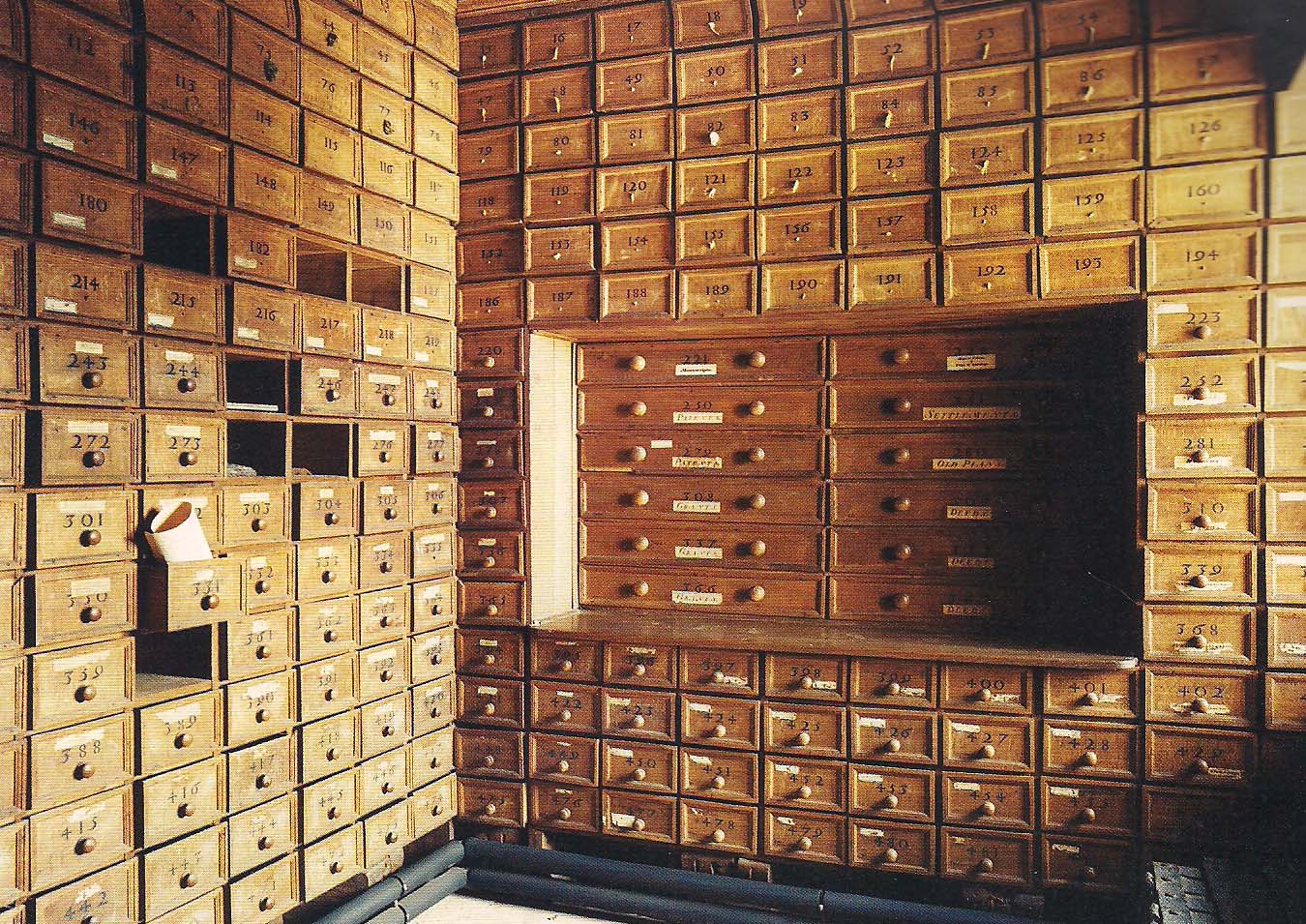
| The muniment room at Hardwick Hall. |
The muniment (ownership document) room on the ground floor of Hardwick Hall is lined with drawers labeled with the names of the Cavendish properties. In 1956, Hardwick Hall was presented to HM Treasury in lieu of Estate Duty. In 1959, the property was transfered to the National Trust which now maintains the house and grounds; it is open year around except for the end of December and the month of January. All these photos were taken by Anthony Crolla and appeared in the November, 2008, issue of "The World of Interiors" magazine; favored rate subscriptions are available
here.
"Custodians, Collectors, and Taste-makers: The Cavendish Women at Chatsworth" is a lecture that looks at the five centuries of influences by Cavendish women on English history and style. It will be presented by Simon Seligman who worked at Chatsworth for 19 years as Education Manager and recently as Head of Communications. He served the late 11th Duke of Devonshire and his wife, now Dowager Duchess, for 13 years, before becoming part of the team supporting the present 12th Duke and Duchess. The talk will also detail the remarkable project currently underway to restore and refurbish Chatsworth; the master plan includes the first ever cleaning of exterior stonework, the creation of new galleries for visitors, a restoration of historic interiors and extensive conservation of the collections. The lecture at Memphis Brooks Museum of Art at 2:00 pm on Sunday, October 9, 2012, is sponsored as an educational event by Decorative Arts Trust, and admission to the talk is free.