Showing posts with label Esmond Harmsworth. Show all posts

Saturday, May 10, 2014

Daylesford's Colefax & Fowler Furnishings

 
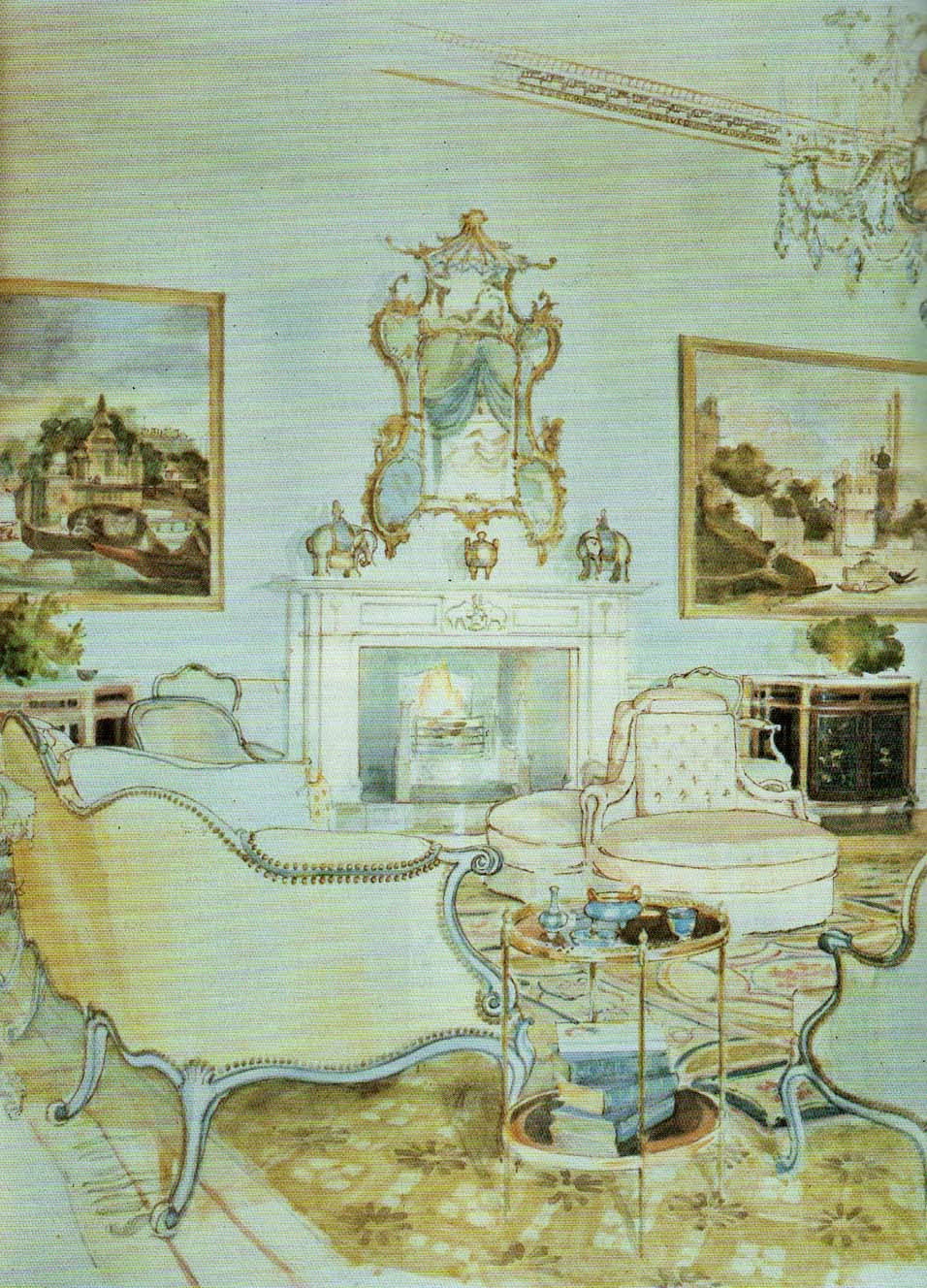
A view of the Saloon at Daylesford
as decorated by John Fowler for the
2nd Viscount Rothermere.
Christie's.
 As Part II in the Notable Homes series on Daylesford, a closer look is given to the furnishings selected by John Fowler and Esmond Harmsworth, the 2nd Viscount Rothermere.  (For the previous post, Part I, click here).  After the viscount died in 1978, his widow and third wife, the former Mary Murchison, returned to live in the U.S. where she died in 1993 at age 62 in a West Palm Beach, Florida, hospital.  A native of Dallas, Texas, Viscountess Rothermere was the daughter of Kenneth Murchison, the founder of a successful insurance partnership, and the niece of Clinton W. Murchison, once one of the world's wealthiest men.  According to her obituary, she maintained homes in Palm Beach, Manhattan, Monte Carlo, and Newport, Rhode Island where she was a supporter of Save the Bay.  In addition, she served on the board of directors of Stratford Hall Plantation in Virginia and the Salk Institute in La Jolla, California.  Although it was her stepson and step-grandson who inherited the viscountcy, her six sons by a previous marriage and her son with Esmond were well taken care of by a trust that included some shares in the Daily Mail and Daily Standard group of newspapers; a 1997 partial sell-off of shares netted her seven sons GBP 163 million.

A view of Daylesford from the
Image from VIEWS OF THE SEATS OF
NOBLEMEN AND GENTLEMEN
OF ENGLAND,WALES, SCOTLAND AND IRELAND

by J.R. Neale, 1823.
Although Daylesford House had been sold (with the next owners to be discussed in following posts), many of the furnishings remained with Mary, Viscountess Rothermere until a sale on April 16, 1994, in New York at Christie's.  So there were no photos in the catalogue of the furniture in situ at Daylesford, but some of the lots could be seen in a series of delightful but uncredited watercolors, included in this post.

Another watercolor view of the Saloon
at Daylesford as decorated by John Fowler.
Image via Christie's.
Among the most memorable furnishings during the Fowler period at Daylesford are the suite of seat furniture by Thomas Chippendale for Sir David Garrick.  Of course, Chippendale is one of the most famous names in furniture, but Garrick, an acclaimed actor and manager of the Drury Lane Theatre, was a celebrity in his time.

David Garrick's Hampton Villa.
Married to the famous Viennese dancer Eva Marie Viegel, Garrick purchased a furnished villa on the banks of the Thames on the outskirts of London in Hampton in 1754.  Utilizing the top talent of the day, he employed Robert Adam for architectural improvements, Jean Pillement to decorate the drawing room walls with chinoiserie painting, and Capability Brown to landscape the grounds.  From 1768 to 1778, Chippendale was involved with the interiors and the work was documented in bills, correspondence, inventories, and sale catalogues.  An invoice, provided in the Christie's catalogue, which runs from 21 May to 23 September 1768, lists the seat furniture as follows:

      David Garrick, Esq
      To Thomas Chippendale
1768                                                                                L  s  d
Aug 3
      To 8 French Arm Chairs very neatly
      Carv'd & painted Blue & white, stuff'd
      & cover'd with your own Blue
      Damask & Brass nail'd                                         24  -  -
      To 2 large Tub Chairs carv'd &
      painted to match stuff'd & Cover'd
      with damask & large Down Cushions
      for the seats                                                           12  -  -
      To a large French sofa to match the
      Chairs and cover'd with your damask
      & nail'd & a large Feather Cushion
      Blue Cheque cases for the sofa & Cushion            2  -  -                                                  
 

In addition to this commissioned suite of furniture, Chippendale altered and repaired Garrick's existing furniture.  Also, Chippendale made a bed (now painted green and white) to match this suite that is exhibited in the collection at the Victoria and Albert Museum (click here to see access. no. W.21-1917)


A pair of George III painted bergeres,
circa 1768 by Thomas Chippendale
from the Saloon of Daylesford.
Christie's.  Lot 142, Sale 7906.

A set of six George III painted armchairs,
four circa 1768 by Thomas Chippendale,
two of a later date.  From the Saloon at Daylesford.
Christie's. Lot 143, Sale 7906.
A view of the Saloon showing the back of the settee
en suite with the previous seating.
The settee was of a later date, commissioned by
John Fowler, but it is presumed that all had
the same yellow fabric.  The settee was offered in
the catalog as Lot 144 but was not pictured.
The suite is included in a 1779 inventory when Garrick died and again in the sale catalogue when his widow died in 1823.  Her solicitor bought the house and many of the furnishings, but when the house and contents were sold again in 1864, the suite did not appear in the auction catalogue.  The whereabouts were unknown until Colefax & Fowler assistant Tom Parr found them during John Fowler's decoration of Daylesford.  The existing paint finish was scraped down to find traces of the old blue and white decoration;  thinking the paint finish was more stylish than gilding, Fowler had them painted grey-blue and antique white.
A George III giltwood mirror,
circa 1765, in the manner of John Linnell
from the Saloon at Daylesford.
Christie's. Lot 161. Sale 7906.
A pair of Regency lacquer-mounted and grained rosewood
side cabinets from the Saloon at Daylesford.
Each with a later black slate top.
Christie's. Lot 162. Sale 7906.
The Dining Room at Daylesford
during the Rothermere residency.
Image via Christie's.


A pair of  George III cut-glass, ormolu and blue glass
three-light candelabra, late 18th century.
Christie's.  Lot 96, Sale 7906.
A Regency mahogany four-pedestal drop-leaf
dining table, early 19th century.
Christie's. Lot 186, Sale 7906.
A set of 10 Regency chairs along with 8 of a later date
commissioned by John Fowler for Viscount Rothermere.
Christie's Sale 7178, 2005.
The largest room of the house is the sitting room known as the Long Gallery.  It was comfortably furnished for everyday use. 

The Long Gallery at Daylesford
during the Rothermere residency.
Image via Christie's.

A Scottish George III mahogany open armchair,
mid-18th century.
Christie's. Lot 131, Sale 7906.
A Queen Anne stool, together with a matching copy
of a later date.
Christie's. Lot 164, Sale 7906.
A Louis XVI ormolu-mounted and brass-inlaid ebony
longcase regulateur with equation of time, circa 1780.
The case stamped J. JOLLAIN twice.
Christie's. Lot 113. Sale 7906.

Another view of the Long Gallery
during the Rothermere residency.
Christie's.


The Morning Room pictured in JOHN FOWLER, PRINCE OF DECORATORS and discussed in the previous post of The Devoted Classicist is also known as the Chinese Room because of artwork.  In the reflection in the mirror, note the curtains designed by Fowler and how the swags connected around the curved bay.

The Morning Room at Daylesford
during the Rothermere residency.
Image via Christie's.
A pair of Regency ormolu-mounted rosewood side cabinets,
early 19th century.
Christie's. Lot 130, Sale 7906.
The Library at Daylesford
during the Rothermere residency.
Christie's.
An early George III mahogany kettle stand
with a later canted square top.
Christie's. Lot 172, Sale 7906.
An English bronze bust of Warren Hastings
cast from a model by Thomas Banks.
See the previous post for more on Hastings.
Christie's. Lot 1, Sale 7906.
Another view of the Library at Daylesford
during the Rothermere residency.
Christie's.
Portrait of Warren Hastings
by Lemuel Francis Abbott.
Christie's London, April 15, 1994.
The auction catalogue consisted of property from the estate of Mary, Viscountess Rothermere, and was not limited to furnishings that had been at Daylesford.  The portrait of Warren Hastings might have been at another residence, but that is unlikely and is shown here because of the significance to the history of the house.

Portrait of Margaret Layton of Rawdon,
circa 1620, oil on panel.
Christie's. Lot 191, Sale 7906.


 Margaret Layton's doublet,
the jacket or waistcoat seen in the portrait.
Linen embroidered in silver and silver-gilt thread,
with sequins and gold lace, lined in pink silk.
English, circa 1620 to 1620.
Christie's.Lot 192, Sale 7906.
(A pair of matching leather gloves was offered as Lot 193).
The portrait of Margaret Layton and associated garment were most likely from the Rothermere's London mansion Warwick House.  Facing Green Park, it was built 1770 to 1771 to a design by Sir William Chambers (the architect of Somerset House, the pagoda at Kew, and Albany), but largely rebuilt during the 19th century in the French Renaissance taste.  Purchased in 1924 by Esmond Harmsworth (before he was a viscount), the principal rooms were remodeled in the 18th century style.  A photo of the Rothermeres posing with the portrait and jacket in the background was shown in the previous post.

The catalogue also showed silver and art from the estate that was offered in 13 additional specialty auctions in New York and London, including a portrait by El Greco.

The next post of The Devoted Classicist will present Daylesford as it was decorated by Renzo Mongiardino during the residency of its next owner, Baron Hans Thyssen-Bornemisza.

Thursday, May 1, 2014

Notable Homes: The Viscountess and Viscount Rothermere at Daylesford

Daylesford House
in Gloucestershire, England.
Watercolor image via Christie's.
Some consider the interiors Daylesford to be one of the greatest works of legendary decorator John Fowler.  The 2nd Viscount Rothermere, Esmond Harmsworth, was 47 when he bought Daylesford in 1946.  The late 1940s, 50s, and early 60s were the golden age for collectors like Harmsworth as there was wave after wave of treasures coming on the market.  Also, there were inspiring exhibitions to stimulate interest in the English Taste and new books about 18th century furniture and architecture.  Lord Rothermere's historically-based restoration with the advice of John Fowler was unusual for a private home in the early 1960s, however, despite the significance of the house. 
An architectural rendering of the east (entrance) elevation
of Daylesford by Simon Vernon.
The Daylesford estate was the ancestral home of the Hastings family.  One of the most important figures in  18th century Anglo-Indian history was Warren Hastings who essentially created the base for British supremacy in India.  Beginning with a career in the service of the East India Company, he rose to become the first Governor-General of Bengal, the richest and most powerful of the Indian states.  Unlike many of his contemporaries who were only to extract wealth from India, Hastings was noted to place national interests, both British and Indian, above his own personal gain.  Hastings introduced policies that respected native traditions and the local princes and maharajahs, but clamped down on corruption.  However, political opponents turned public opinion in London and India against him, resulting in his being recalled to London to face charges of embezzlement, fraud, abuse of power and cruelty.  A trial before the House of Lords lasted seven years before Hastings was exonerated of all charges.  But he never returned to India.

The west elevation of Daylesford
in an architectural rendering by Simon Vernon.
In 1788, just as the trial was beginning, Hastings bought back the manor house and estate of Daylesford dating from the medieval period that had been sold when he was a child.  Employing architect Samuel Pepys Cockerell, Hastings set out to create a monument to his career that would house his ever expanding art collection.  (The architect was later to design the fantastic Sezincote House nearby for his brother Samuel Charles Cockerell, Surveyor to the East India Company).  As many of the paintings in Hastings' collection were on the subject of India, it was fitting that the house would have detailing that would be reminiscent of the exotic architecture of that country.  The cabinet makers Ince and Mayhew supplied furniture and textiles.  Although no longer in public disgrace, Hastings was content to life in self-imposed exile in great comfort with his family and friends at Daylesford.

The south elevation of Daylesford
in an architectural rendering by Simon Vernon.
In 1853, the house and contents were dispersed by his stepson, and the house and estate passed through several owners before being purchased in 1946 by the 2nd Viscount Rothermere.

Lord and Lady Rothermere
with son Esmond Vyvyan Harmsworth, in the 1970s.
Image via Christie's.
Lord Rothermere had not only the enthusiasm, but also the means, to restore the house to reflect Warren Hasting's late 18th century transformation of Daylesford.  There are some jobs on which John Fowler was said to have "pulled out all the stops" and Lord Rothermere was an appreciated, insightful client who brought out Fowler's sympathy for the house. 
A view to the Entrance Hall (and beyond)
from the Long Hall.
The entrance to the house had been changed in 1855 by Edward Kemp, moving from the south to the east with the principal reception rooms arranged with a southern exposure.  All had classical decoration but was in poor condition by 1946.  Architect Philip Jebb was brought in for the renovation with the assistance of John Fowler.  The restoration of the Anglo-Indian architecture was compliemented by furnishings in the Anglo-French fashion of the late 18th century based on contemporary documents.
The Saloon at Daylesford as decorated by
John Fowler for Lord Rothermere.
A view of the curtains can just be glimpsed
in the reflection in the mirror.
Image from JOHN FOWLER PRINCE OF DECORATORS.
While Lord Rothermere sought out particular items that had belonged to Warren Hastings, Fowler used written descriptions of the interiors as a basis for the new decoration.  Although not a historical recreation in terms of a museum setting, the furnishings of Daylesford were intended to be in the style that had appealed to Hastings.
Another view of the Saloon at Daylesford.
Image from JOHN FOWLER PRINCE OF DECORATORS.
Colefax & Fowler assistant Tom Parr found a suite of armchairs and settees for the Saloon that had been made for David Garrick.  In the French taste by Thomas Chippendale, the suite will be presented in more detail in the following blog post featuring the furniture.  Although the color of the walls does not come through in these photographs, they were said to have painted by John Fowler in 'periwinkle blue' to match the results of his paint scapings and the contemporary accounts of the original decoration of the room.  An Indian carved ivory games table added to the exotic theme of the room, as did two large Indian pictures.  A blue banquette in the alcove was decorated with velvet cushions that were hand painted in the same decoration to match the curtain borders.

The sample board for the Saloon, left.
The original border for the curtains, right,
found after the death of John Fowler.
Images via JOHN FOWLER PRINCE OF DECORATORS.
The contemporary documentation had also described the curtains as having painted borders with sequins.  With Tony Watkins and George Oakes, Fowler painted the borders on ivory velvet using copper stencils he had made, using antique bell pulls as inspiration.  After the borders were sewn onto pale blue satin curtains, they were edged in sequins.  (When Stanley Falconer worked at Daylesford for the present owners, he discovered a fragment of the orginal curtains that had been preserved with the Hastings furniture in another collection to be very similar to what Fowler had produced, and had the borders copied and the curtain fabric dyed to match the original.  More about the present owners of Daylesford will follow in a future post).
The Evening Room at Daylesford
decorated by John Fowler.
Image via JOHN FOWLER, PRINCE OF DECORATORS.
The Evening Room, facing west, was painted a very pale grey to compliment the yellow-tinged light from the setting sun.  The curtains were mustard colored with bullion fringe and cording.  Much of the upholstered furniture was covered in yellow silk, picked up in the colors of the 19th century needlework rug.
The Morning Room at Daylesford
with John Fowler's curtains as they were realized
and how they were planned.
Image via JOHN FOWLER PRINCE OF DECORATORS.
The Morning Room which faced east was painted off-white with details of the cornice picked out in gold.  Using the colors in the Aubusson rug, Fowler devised a fresh color scheme for the room.  According to Martin Wood in JOHN FOWLER, PRINCE OF DECORATORS, the curtain panels were made of sewn-together strips of taffeta in celadon green, French blue and dull apricot; the French blue pelmets were swagged and scalloped with an apricot lining and fringed apron.  Wood says that John Fowler's curtain sketches were annotated by his long-time assistant Imogen Taylor.  In the sketch above, another hand has written "Lath Line" and drawn two horizontal lines to indicate the framework that was needed for support.  Below that, the notes presumably by Taylor indicate an earlier scheme, "Blue Tails & over Sways.  Green linings & under Swag." 
The Dining Room at Daylesford.
Image via JOHN FOWLER PRINCE OF DECORATORS.
The furnishings of the Morning Room, also referred to as the Chinese Room, along with the Dining Room and the Study will be discussed in detail on the next post.
Lord Rothermere's Study at Daylesford.
Image via JOHN FOWLER, PRINCE OF DECORATORS.
As always in Colefax & Fowler projects, the guest bedrooms were treated in detail to make them very individual and comfortable. 
John Fowler designed a tent wardrobe
similar to a Mughal tent
for a guest bedroom needing a closet.
Image via JOHN FOWLER, PRINCE OF DECORATORS.
Additional guest rooms at Daylesford.  The Red
Bedroom is pictured on the left.  Another
guest room has walls covered in "Print Room' toile.
Image via JOHN FOWLER, PRINCE OF DECORATORS.
The guest room with walls covered in a toile
giving the effect of a print room.
Photo from COLEFAX & FOWLER
THE BEST IN ENGLISH INTERIOR DECORATION.
 
 
Lord Rothermere succeeded his father Harold Sidney Harmsworth, the very successful owner of Associated Newspapers Ltd who developed the Daily Mail and the Daily Mirror newspapers and a 1930s supporter of Germany (convinced the Nazis would restore the German monarchy), in the viscountcy in 1940. His first marriage, 1920 to 1938, resulted in two daughters and a son, Vere, who became the 3rd Viscount Rothermere after his father's death in 1978.  (Vere was married, Devoted Readers will recall, to Bubbles Rothermere who was the subject of the previous post here).  His second marriage, 1945 to 1952, also ended in divorce (with his ex-wife marrying James Bond author Ian Fleming that same year).  His third marriage, in 1966 to Mary Murchison, produced a son in 1967 (prompting Vere and Bubbles to have another child, a son who would become the 4th and present Viscount Rothermere).
A guest room at Daylesford decorated by John Fowler
using "Hollyhock' chintz as the primary fabric.
The hand-blocked print is still produced for Lee Jofa.
Image via JOHN FOWLER, PRINCE OF DECORATORS.
The next post in this series of The Devoted Classicist will feature the interiors and specific antique furnishings of Daylesford as created by the 2nd Viscount Rothermere and John Fowler as it appeared until the dispersal at the death of Mary Harmsworth, Viscountess Rothermere.