 |
The garden of Le Pavillon Frais
near the Petit Trianon.
Photo: Versailles. |
J'adore le treillage! Yes, Bunny Williams' and John Rosselli's
shop of course, but I am referring to the French term for architectural trellis-work,
treillage.
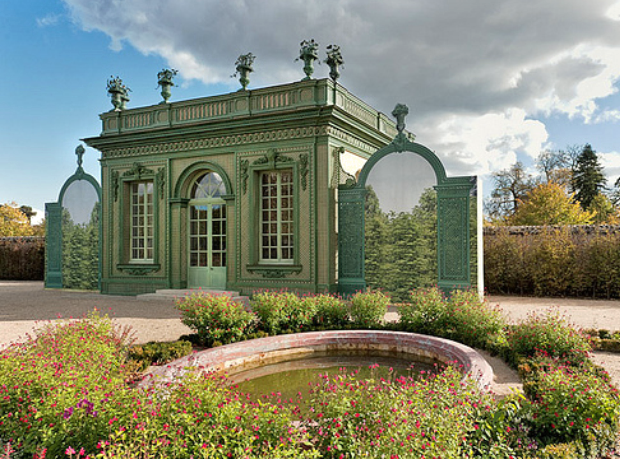 |
Pavillon Frais with partial mock-ups
of the flanking arcades.
Photo: Versailles. |
There is a small garden structure near the Petit Trianon at Versailles that is sometimes referred to as the Pavillon du Treillage because it was covered with trellis-work. But the official website of the chateau refers to it as
Pavillon Frais, so that name will be used here. Both the building and the surrounding garden have recently undergone a very interesting restoration.
 |
Drawing of Pavillon Frais dated December, 1751.
Image: Archives Nationales. |
At the encouragement of
Madame de Pompadour, King
Louis XV settled at the Grand Trianon in 1749, away from the rigid court formality of the palace, and away from the courtiers who disapproved of her being the favorite of the king. (Previously, the mistress of the king was of high noble birth, but Jeanne Antoinette Poisson who was given the title of
Marquise by the king came from a non-aristocratic background, though she was particularly well-educated). The royal architect
Angel-Jacques Gabriel designed additional Trianon gardens and, in 1750, was asked to design a pavilion in the middle of a garden laid out in geometric beds, contrasting with the trend in English gardens for a more natural landscape. Both the pavilion and the garden began to be known as "French" because of this new style. A menagerie was added nearby, not for exotic animals, but for cows, chickens, and similar animals. In 1751, another small pavilion designed by Gabriel was added consisting of a small dining room where the fresh products of the diary and vegetable gardens could be served; this was known as the Pavillon Frais.
 |
In this site plan, the Pavillon Frais is in the lower left corner
above the wording "Avenue".
The French pavilion is the shaped building above it.
Image: American Friends of Versailles. |
The garden in front of the pavilion was surrounded by trellis-work creating a courtyard. An arcade of trellis covered iron supports against a dense hedge flanked the pavilion, installed in July, 1752, at the same time as the trellis design covering the pavilion.
 |
In this site plan detail, the Pavillon Frais
can be made out, backing up to the tree-lined avenue,
with the courtyard garden in front, above.
Image: Versailles. |
The entrance to the garden consisted of lattice piers built around the trunks of lime trees pruned into the shape of spheres. The main piers were like the pilasters of the pavilion and mounted with large wooden trellis urns. Fifty-four smaller urns adorned the keystones of the archways of the arcades, each with an orange tree. In 1756, statues of "Illness" and "Health" from the Antiques Room of the Louvre were placed on marble plinths at each end of the arcades.
 |
This 1751 plan of Pavillon Frais by Gabriel has a reversed orientation
from the two previous garden plans,
with the northern direction towards the bottom.
Image: Wikimedia. |
The one room interior was primarily used for dining on pleasant spring and summer days, although there was a fireplace with a Languedoc marble chimneypiece. The walls were painted
boiserie decorated with carved floral garlands and inset sheets of mirrored glass. The floor was a black & while marble checkerboard covered with a large Savonnerie carpet, commissioned in 1754 but not completed until 1760. The furniture included two
canapés and two
fauteuils upholstered in green & white
toile de perse, a chic but casual cotton fabric with a printed Persian floral design. A later inventory also included sixteen assorted side chairs.
 |
The interior of Pavillon Frais
as it appeared in 2013,
with representations of the boiserie.
Image: Wikimedia. |
The pavilion was essentially destroyed in 1810, with only the foundation remaining, and the lattice courtyard enclosure was pulled down the next year. Some restoration was begun in 1980, enabling the stone structure to be reconstructed, but more progress was realized when a support group,
The American Friends of Versailles, took the project on.
 |
The restored garden elevation of Pavillon Frais
by the office of the Chief Architect of Historic Monuments,
Pierre-Andre Lablaude.
Image: the Facebook page of
The American Friends of Versailles. |
Test pits and archaeological excavations found the original locations of the basins as well as fragments of their remains.
 |
'Before' and 'After' views of Pavillon Frais
showing the restoration efforts of
The American Friends of Versailles.
Images: Facebook. |
The fragments of the bottom of the basins revealed a mosaic design in marble that were reproduced in the restoration.
 |
One of the pair of restored basins
in the garden of Pavillon Frais.
Image: Facebook. |
The flanking arcades and courtyard enclosure have not been recreated, but a representation of how that would look is given with two flat theatrical mock-ups flanking the pavilion.
 |
The back of the arcade mock-up
at the Pavillon Frais.
Image: Facebook. |
The treillage on the building has been wonderfully restored, however, by the French company which specializes in such work,
Tricotel.
 |
The restored entrance doors of
Le Pavillon Frais.
Photo: Tricotel. |
 |
The original layout of treillage
was created for Pavillon Frais.
Photo: Tricotel. |
With the success of the work so far, perhaps the recreation of the interior and the arcades will follow. The American Friends of Versailles has also sponsored the restoration of the Trois Fontaines Bosquet and is dedicated to preserving interest in Versailles through seminars and educational exchanges as well as specific restoration projects at the palace and its gardens.
 |
Le Pavillon Frais.
Photo: Tricotel. |
Those more interested in plant material than garden structures will enjoy Elisabeth de Feudeau's book published in September, 2013,
FROM MARIE ANTOINETTE'S GARDEN: AN EIGHTEENTH-CENTURY HORTICULTURAL ALBUM. Based on archival documents, the book uses eighteenth-century illustrations to present the plants, flowers and trees loved for their beauty, scent, and herbal qualities.


