Saturday, September 3, 2011

La Fiorentina Furnishings

This essay is the third of a consecutive series of The Devoted Classicist with the common link being decorating legend Billy Baldwin. His scheme to revitalize the internationally renown Saint Jean Cap Ferrat villa La Fiorentina became an iconic example of interior design with popularity that endures to this day. The 1999 buyer of La Fiorentina purchased it fully furnished, but sold all the contents in a celebrated 2001 auction at Sotheby's New York. The lots consisted mostly of the furnishings selected by Billy Baldwin for Mary and Harding Lawrence, but also some items from the previous owners Roderick "Rory" Cameron and his mother Enid, Lady Kenmare, and even some items included by the new owner.

While the primary sitting room was undoubtedly a glorious space, with a beautiful courtyard on one side and a view down stepped turf steps to the pool and sea beyond, some might be surprised at the number of architectural inconsistencies from what one might expect in a classical room.  The space, which is called the Main Drawing Room in the Sotheby's catalog, was not a classic rectangle in plan, and the French doors had arched transoms on one side and flat head transoms on the other.

In this view from the courtyard towards the Main Drawing Room, one can see the line in the stucco where two floors were added in the rebuilding by Roderick Cameron and his mother Enid, Lady Kenmare.  It is presumed that the interpretation of the checkerboard parterre was the work of noted garden designer Russell Page.

In the descriptions of furnishings from the 2001 Sotheby's catalog, Sale 7638, that follows, the price shown is the Hammer Price plus the Buyer's Premium.
A Louis XV style marble chimneypiece, from the Cameron-Kenmare rebuilding, $14,400.
A Louis XV giltwood mirror, mid 18th century, 7 ft 1 in. by 4 ft 1 in., also from the collection of Cameron-Kenmare and visible in the photo of the room in the previous post of The Devoted Classicist.  $12,000.
Two similar Chinese export blue and white baluster urns with handles, 25 inches high, $4,500.
A Chinese export blue and white porcelain charger, 18th century, in the Kangxi style.  $6,600.
A blue and cream wool carpet designed by Billy Baldwin, one of a pair, both 12 ft 2 in by 9 ft 8 in.  Each sold for $7,200.
A Chinese export style black lacquer low table, modern, designed by Charles Sevrigny, 60.5" by 49" by 17.5", $6,600.
Sevrigny was a popular French furniture and interior designer in the 1960s and 70s;  he also designed the lighting for this room.
A contemporary pale blue upholstered four seat sofa with six additional decorative silk pillows, $11,400.
A pair of pale blue cotton upholstered armchairs, $4,800.
A view of the Main Drawing Room, opposite the fireplace.  The pairs of French doors with flat-head transoms open to a gravel terrace and broad turf steps down towards the sea.
A Louis XVI fauteuil a la reine, third quarter 18th century, signed J.M. Pluvinet, $6,600.

A set of four Louis XV/XVI painted fauteuils a la reine, circa 1770, $36,400.
A pair of Billy Baldwin designed two-tiered upholstered tabourets, 20.5" x 20.5" x 15.5", $12,000.

A pair of metal wire end tables designed by Warren Platner, circa 1970, manufactured by Knoll, missing glass tops, 18" high. $3,000.
A pair of brass three-tiered side tables, 20th century, designed by Billy Baldwin, missing glass shelves, 28.25" high, $6,000.


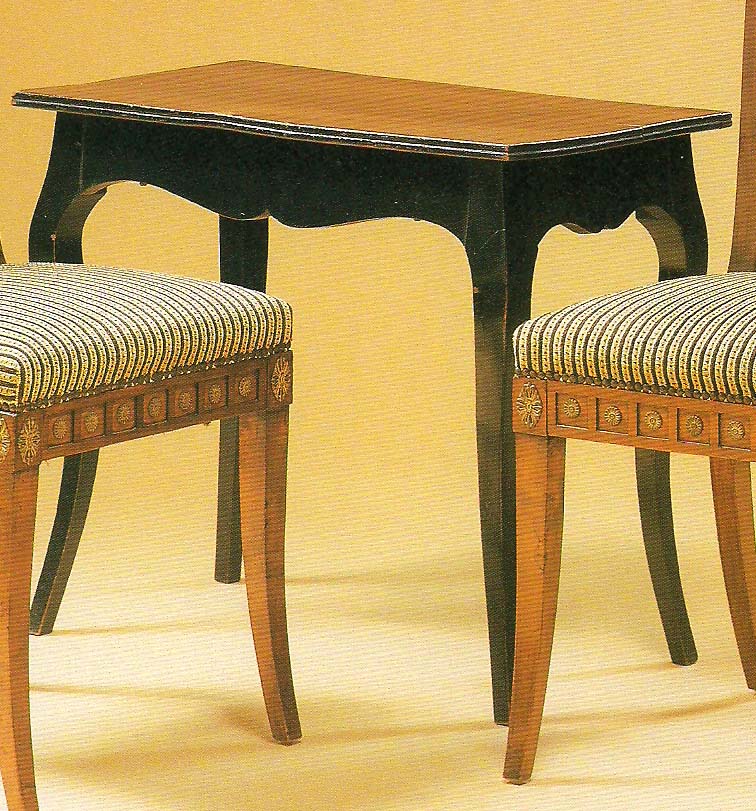
A Louis XV provincial ebonized table a ecrire, mid 18th century.
There were a couple of small black writing tables used as end tables in this room, but it cannot be determined from the photos if this and the following example were actually from that room.

A Louis XV style ebonized table a ecrire, $1,920.

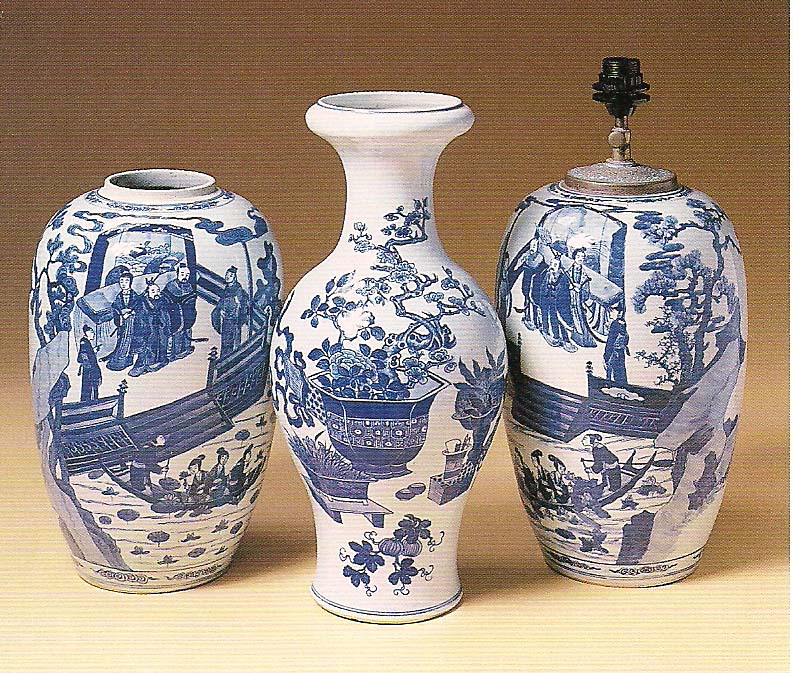
A pair of Chinese export blue and white porcelain ovoid jars, one fitted as a lamp, together with a baluster-shaped urn.

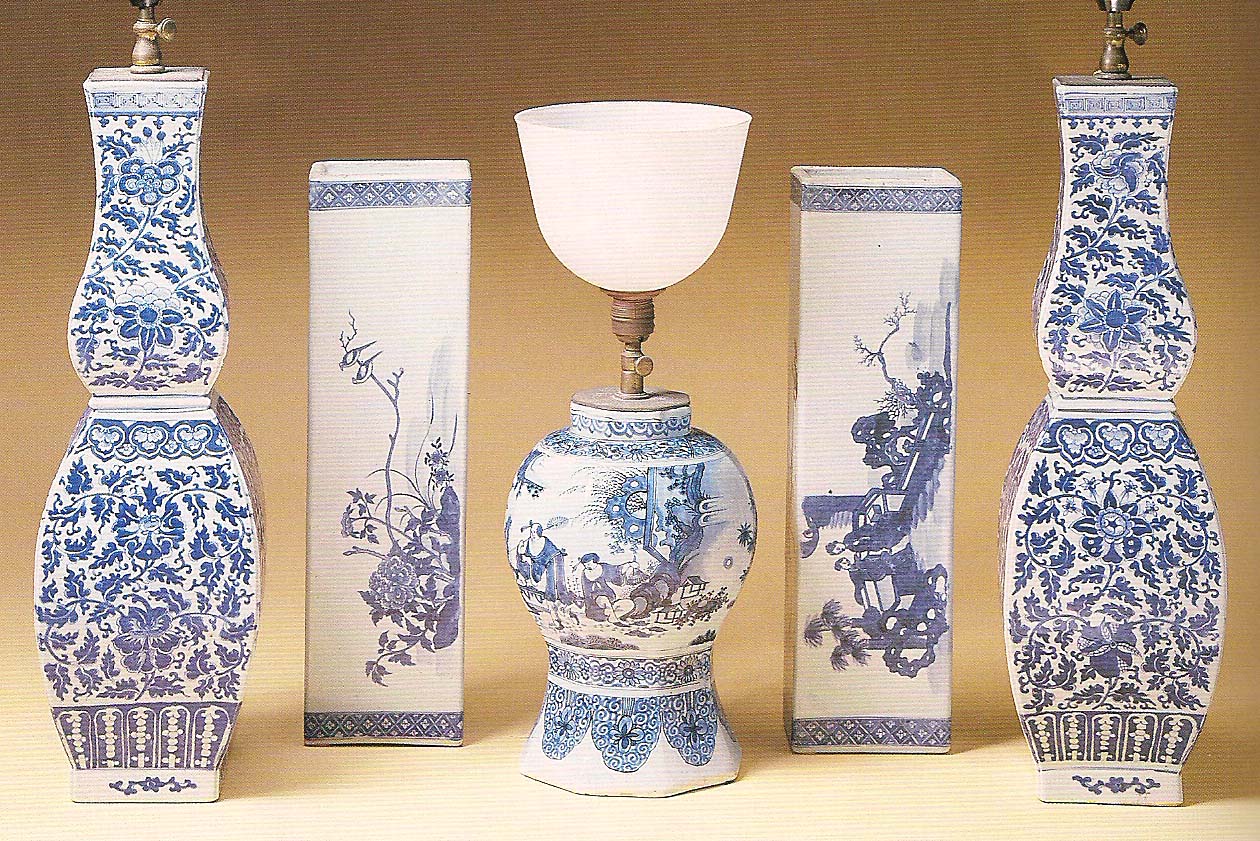
A pair of Chinese export blue and white porcelain double gourd vases now mounted as lamps.
A pair of Chines export porcelain blue and white porcelain headrests.
A German blue and white pottery baluster-shaped jar, circa 1700, now mounted as a lamp.


Kenzo Okada, 1902-1982, ISLAND, oil on canvas, 73 by 48.75 inches, circa 1954-55.  $21,450.
A pair of white linen three seat upholstered sofas, 6 ft 10 in. by 34.5 in. deep by 28 in. high.  $10,200.
A view towards the Gallery with Martin Battersby murals (outside the Dining Room) and the Entrance Hall beyond.
A Louis XV style ormolu-mounted ebonized bureau plat, last quarter 19th century, 6 ft 9 in by 30 in by 32.5 in high, $23,750.

Two similar Wedgwood style black basaltware urns on stands, raised on modern ebonized bases, 38 in. high.  $6,600.

A pair of Louis XVI style black lacquer and parcel-gilt bookshelves fitted at the sides with Chinese export lacquer panels, 86.5" long, $12,000.

A pair of Chinese export blue and white baluster-shaped jars and covers, 25" high, $4,800.

Theodoros Stamos, b. 1922, GRAND BLUE SUN-BOX, 68 by 60 in., dated 1969.  Note that the painting is installed reversed from this image in the photo of the room.

A pair of Louis XVI style ormolu three-light bras de lumieres, 19th century, 29 in. high by 20 in. wide.


The Main Drawing Room of villa La Fiorentina as decorated by Billy Baldwin.


The views of the room are from BILLY BALDWIN REMEMBERS by Billy Baldwin, 1974;  vintage copies of this book may be purchased here.  The furnishings are from the Sotheby's New York auction catalog Sale 7638 and vintage copies of the catalog may be purchased here.

Thursday, September 1, 2011

Notable Homes: La Fiorentina

The previous post of The Devoted Classicist profiling decorator Ruby Ross Wood, mentor to the legendary Billy Baldwin, is a prelude to this essay.  I had asked my friend and Baldwin authority James Archer Abbot for a comment about La Fiorentina, the Saint Jean Cap Ferrat villa that Baldwin had decorated for Mary and Harding Lawrence. The Living Room is one of the iconic rooms of 20th century interior design, and influential in decoration to this day with new versions appearing often with only minor variations.  James had participated in a special Panel Discussion sponsored by Sotheby's in 2001 on the topic of American interior decoration of the 1960s and 1970s so I knew he would have an interesting contribution to this story.  As usual, Mr. Abbott did not disappoint.  But first, some background on the notable home.


The Gallery of La Fiorentina during the ownership of Roderick Cameron and Lady Kenmare.  Note the Martin Battersby painted ceiling, appearing to be drawings pinned in place.
 Source of Google image is not identified.
The Devoted Classicist has been enthralled by La Fiorentina since he was a youth, seeing black & white photos of the remarkably chic villa in French magazines and books published by Librairie Hachette.  A classical villa handsomely furnished with a notable mix of Louis XVI antiques as well as good reproductions and decorative exotic pieces, my most memorable impressions were how elegant yet comfortable the house appeared.  And most of all, I was impressed by the decorative trompe l'oeil paintings by Martin Battersby that represented classical architectural drawings that appeared to be pinned in place.  Following a career as an actor and theatrical set designer, Battersby became a muralist after World War II.  In addition to his work at La Fiorentina, he was known for his murals for Lady Diana Cooper's chateau near Chantilly and for the Carlyle Hotel in New York City.
A trompe l'oeil mural by Martin Battersby in the Gallery. In the Dining Room beyond, Lady Kenmare, once a scenic painter in Hollywood, painted a curtain (not seen in this view) to match the mural.
Photo:  La Decoration by Librairie Hachette, 1962.
The house as I first knew it was home to Lady Kenmare and her son Roderick Cameron, known as Rory to his friends.  The many-times-married-and-widowed mother was nicknamed "Lady Kilmore" by her neighbor Somerset Maugham but there was no evidence she had anything to do with the deaths of her husbands.  The Cote d'Azur has been a sea-side destination for international society and titled heads of Europe, not to mention American millionaires and their marriageable daughters, since the end of the 19th century and continuing to this day.  This house began as the winter residence of the Countess Therese de Beauchamp, built starting in 1914 as a Florentine palazzo and hence the name.  Originally, Aaron and Gaston Messiah were hired as the architects with Harold Peto to design the gardens, but they were replaced by writer, architect, and garden designer Ferdinand Bloc.  By the early 1920s, the countess had moved on to one of the most spectacular villas in the area La Leopolda, designed by Ogden Codman, Jr., as his own residence, (see my December 11, 2010 post for more about Codman), and sold La Fiorentina to Sir Edmund Davis.  Although not well-known today, Davis, 1862-1939, was an Australian-born mining financier and art collector who had a number of notable houses in addition to this one and bequeathed a large part of his exceptional collection to museums in Paris and Cape Town.  Lady Kenmare, also Australian-born, bought the villa in 1939.  But when Enid, Lady Cavendish as she was then known, returned to the Riviera after World War II, she found that the villa and gardens had been virtually destroyed by the retreating Nazis.

The Living Room of La Fiorentina during the ownership of Rory Cameron and Lady Kenmare.
Source of Google image is unidentified.
It was decided to rebuild, or rather recreate, a neo-Palladian villa, and Lady Kenmare and her son Rory combined their efforts to create a magnet for the haut monde.  An elaborate Guest Book recorded the experiences of the celebrated visitors and much about those days is conveyed in Cameron's 1975 book The Golden Riviera.  A record of these heady days were also remembered by Cameron's half-sister Pat Cavendish O'Neill in her memoirs A Lion in the Bedroom (with the title referring to her days in Africa).  Over years and decades, Cameron worked to build the collection of furnishings, buying from top Parisian dealers as well as the bazaars of Tangiers and Bombay.  But as his mother spent more time on her stud farm in South Africa, Cameron decided to move into an auxiliary building on the estate called Le Clos Fiorentina, and rented the villa, and eventually sold it.  The story of this remarkable house and its owners could fill a whole book, but it is the following phase of ownership and decoration that is the thrust of this essay.

American advertising legend Mary Wells was scouting locations for a TV commercial for Betty Crocker to promote their packaged casserole mix named "The Riveria" when she first saw the villa from the water about 10 years before she came to own it.  She founded Wells Rich Green in 1966 and was one of the highest paid women in business.  In 1967, she married a client, Harding Lawrence, a Texas businessman and president of Braniff International Airways.  Together, they were one of the most dynamic couples of the late 60s and early 70s.   In the next few years, they bought a big Dallas house on Turtle Creek Boulevard at the entrance to Highland Park, a sprawling Arizona ranch, and a Manhattan penthouse triplex, all decorated by Billy Baldwin.   Looking for a sea-side retreat that would also serve as venue for entertaining their international clientele, Mary Lawrence remembered the house and had Billy Baldwin arrange the deal to buy it from his friend Cameron in 1970.  Baldwin had often been a guest in the house, and stayed with Cameron in Le Clos Fiorentina for periods while the house was being redecorated for the Lawrences.


Billy Baldwin's decoration of the Living Room of La Fiorentina.
Source of Google image is not identified.
 Baldwin wrote "Not one thing did they wish to see.  I was to buy everything".  But he was also to respect Mary Wells Lawrence's single comment, "Remember . . . we bought the house because of what it is.  Let's not revolutionize it."  Although The Devoted Classicist liked the classic decoration of Rory Cameron's home, he must admit that Baldwin's reinterpretation was fresh and appropriately up-to-date.  The new scheme was most apparent in the Living Room.  Instead of Old Masters, contemporary paintings were sparingly placed.  The former neutral palette was infused with blue in geometric prints and blue and white export ware to give a refreshing lift, and a touch of Baldwin's trademark American pizzazz.  It was James Archer Abbott's comment that made me really appreciate the room in a different light, however.  In the Panel Discussion held in conjunction with the 2001 auction of furnishings at Sotheby's New York, James told me that Albert Hadley, himself a devotee of Billy Baldwin, had remarked on the comparison to the theme of decoration introduced in the Living Room of the Wolcott Blairs in Palm Beach that had been decorated by Ruby Ross Wood with her new assistant Billy Baldwin.  The spaces were similar with French doors on both sides necessitating that there be some floating groups although one sofa could be placed against an end wall.  Interestingly, a desk is centered in both schemes, but that is a placement Baldwin came to use frequently.  The relatively bare walls is one of the more telling comparisons, as is the placement of planters between the French doors.  I had always thought the use of those planters was an interesting choice for Baldwin's scheme at La Fiorentina, although not unusual for the time.  But it really hit home when I saw the tubs of lilies used in Wood's scheme for the Blairs;  it was part of bringing the outdoors in.

The Harding Lawrences lived in La Fiorentina for almost thirty years, and achieved their goal of entertaining there in high style.  Enlisting the help of David Niven, who had done voice-overs for Wells' commercials, introductions were provided to bring Princess Grace as a frequent guest to dazzle the business clients.  Also, Frank Sinatra, Helmut Newton, and Andrew Lloyd Webber were frequent guests.  The Airline Deregulation Act of 1978 ended Braniff and Mary sold her business in 1990.  No longer needing to entertain on such a lavish scale, they sold La Fiorentina in 1999 and moved about 100 yards to Le Clos Fiorentina.  In a New York Times interview by William Norwich, May 17, 2001, they said they had rented Le Clos from Hubert de Givenchy for summer visits and added central air-conditioning along with a satellite TV dish.  La Fiorentina had been sold furnished for an unconfirmed $40 million to an undisclosed buyer.   Although the exterior was protected, the interior was completely demolished.  The Lawrences were not particularly pleased with the auction of the furnishings and the publicity surrounding it.  The auction lots included not only the Baldwin acquisitions but also the furnishings that had been included in the sale from Rory Cameron as well as some added by the new owners.  In the article, Mrs Lawrence is quoted, "What I resent about the Sotheby's auction is that it forces us to live in the past."

I was fortunate to have met Rory Cameron shortly before his death in 1985.  Related to my former Parish-Hadley co-worker Libby Cameron, he visited the office once while in New York decorating the Sutton Place apartment of billionaire media empire owner Anne Cox Chambers.  Decorating professionally came late in life, as I understand, and he was formerly better known for this travel writing and the iconic book The Golden Riviera.

The gardens the work of British landscape architect, Russell Page, perhaps the foremost garden designer of his day.
The next post of The Devoted Classicist will feature the furnishings of La Fiorentina from the 2001 auction.

Note the white-washed tree trunks that reflect the light while guarding against insects.


The recollections of Rodrick Cameron's THE GOLDEN RIVIERA, Pat Cavendish O'Neill's A LION IN THE BEDROOM, and Mary Wells Lawrence's A BIG LIFE (IN ADVERTISING) can be purchased here.  Copies of the vintage Billy Baldwin books including BILLY BALDWIN REMEMBERS can be purchased here. 

Thursday, August 25, 2011

Ruby Ross Wood

Ruby Ross Wood's decoration of the Dining Room of Swan House, the Edward H. Inman residence, Atlanta, features magnificent antique Chinese hand-painted wallpaper and dramatic silk-taffeta curtains.  Although author Adam Lewis described them as horizontal striped, the word from the museum curator, via Helen Young at Whitehaven blog, is that they are indeed plaid.
Photo:  THE GREAT LADY DECORATORS by Adam Lewis.
One of the great decorating talents that helped to shape interior design as we know it is Ruby Ross Wood.  Born Ruby Ross Pope in 1880 in Monticello, Georgia, and growing up in Augusta as the daughter of a successful cotton broker, she moved to New York City in the early 1900s to continue her freelance writing career for newspapers and magazines.  In 1910, she was hired as a ghostwriter for a series of articles for The Delineator magazine to publish the collection of lectures on interior decorating that Elsie de Wolfe had given to members of The Colony Club, an elite women's organization whose Stanford White-designed clubhouse she decorated in 1905.  (Not to be confused with the current clubhouse designed by architects Delano & Aldrich, this was located at 120 Madison Avenue, and is now home to the American Academy of Dramatic Arts).  The next year, she rewrote the articles in cooperation with de Wolfe and sold them to Ladies Home Journal.  In 1913, the articles were again adapted to create the book The House in Good Taste, a compilation of practical and relatively inexpensive suggestions that proved to be very influential in re-shaping tastes in residential interiors for the twentieth century.
The legendary decorator Ruby Ross Wood.
Photo:  THE GREAT LADY DECORATORS by Adam Lewis.
After the financial failures of her own book The Honest House and a decorating firm, Modernist Studio, she accepted a job from Nancy McClelland at Au Quatrieme, the fourth floor antiques and decorating shop in Wanamaker's department store.  When McClelland left in 1918 to open her own decorating firm, she recommended that Mrs. Wallace F. Goodnow, as she was known then, would become the new manager, an experience that would prove to be invaluable in providing connections with important trade sources and wealthy clients.  Divorcing her husband in 1923, she married Chalmers Wood the next year.  With the financial backing of her socially-connected stock broker husband, she took advantage of the departure for France of New York's then-reining Queen of Decorating, Elsie de Wolfe, and opened her own business as Ruby Ross Wood.

The summer home of Chalmers and Ruby Ross Wood in Syosset, Long Island, New York, was designed by architect William Adams Delano of the noted architectural firm Delano & Aldrich with contributions by Mrs. Wood.  Built 1927-28 on 43 acres off South Woods Road (Syosset-Woodbury Road), it was demolished in 1995.
Photo:  THE ARCHITECTURE OF DELANO & ALDRICH by Peter Pennoyer and Anne Walker.
Decorating her own apartment as a showcase for her design skills, and moving every year, she soon built a profitable business from former customers of Au Quatrieme and old money connections of her husband.  Published photos of their country house on Long Island, Little Ipswich designed by architects Delano & Aldrich, also enhanced her reputation.

The Stair Hall at Swan House as decorated by Ruby Ross Wood.  The sitting room through the open doors is labeled "Morning Room" on the construction plans but would commonly known as a Living Room.
Photo:  THE GREAT LADY DECORATORS by Adam Lewis.
The best known design by Ruby Ross Wood, however, is the Swan House, Atlanta, now open as a museum.  The residence of Mr. and Mrs. Edward H. Inman, heir to a cotton brokerage and real estate fortune making him one of the richest men in Georgia, is a classical mansion on 28 acres in the fashionable neighborhood of Buckhead.  Commissioned of the Atlanta architectural firm of Hentz, Reid and Adler, associate Philip Trammell Shutze is generally credited as responsible for the architectural design.  But the whole house was done in close collaboration with both Mrs. Inman and Mrs. Wood.  Although the exterior shows Shutze's influence by the Italian Renaissance, Mrs. Inman's love of early English Georgian design, and William Kent in particular, is given preference inside.  The three worked together according to Adam Lewis, author of The Great Lady Decorators, on all the interior architectural details (with the exception of the library whose millwork was executed in England).  It is the Dining Room, in particular that showcases Mrs. Wood's talent.  Antique Chinese wallpaper, as advocated by Elsie de Wolfe, gives life to the room filled with English furniture.  And the Ruby Ross Wood signature of color is given by the bold plaid silk taffeta curtains.
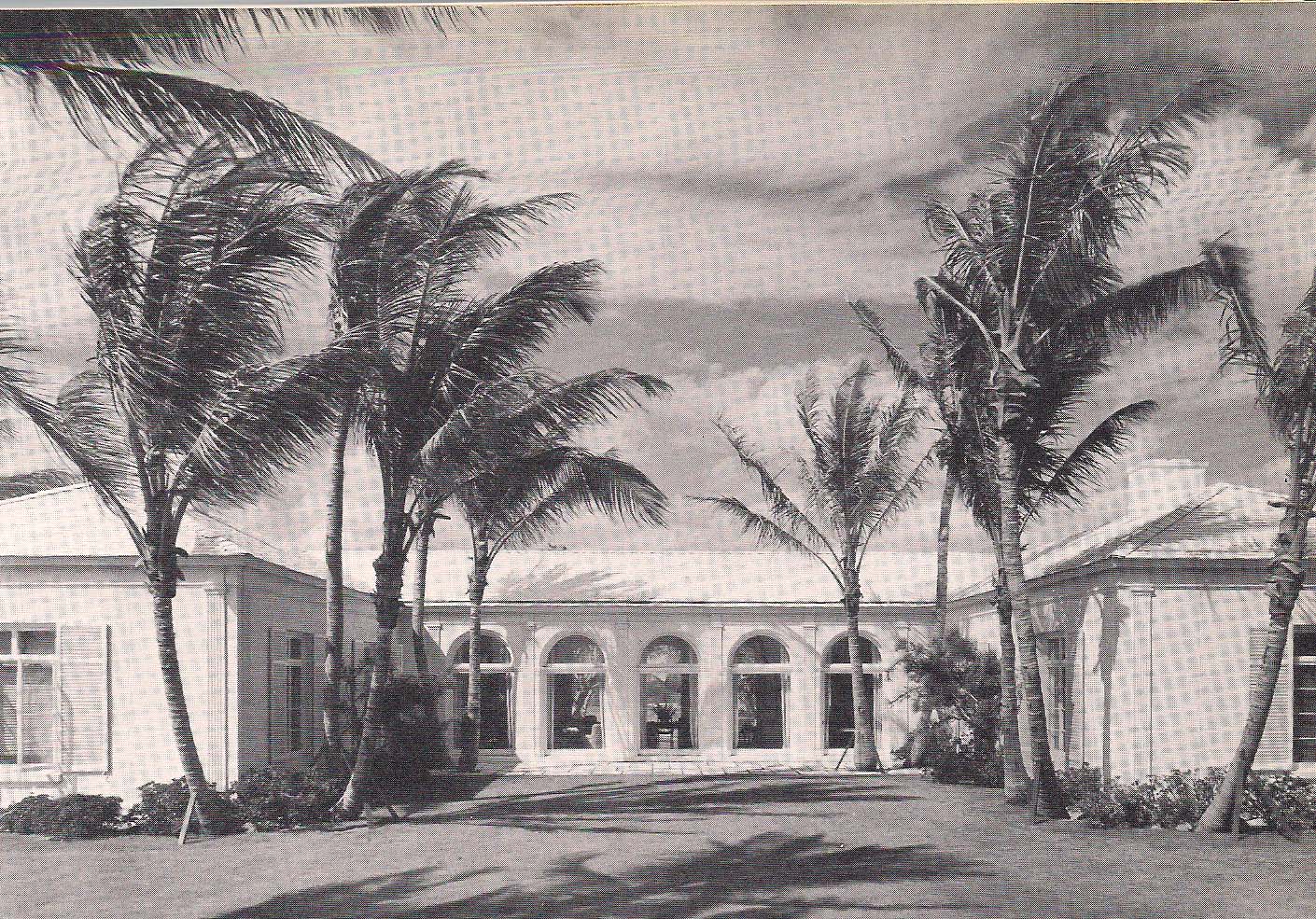
The winter residence of Mr. and Mrs. Wolcott Blair in Palm Beach, Florida, was designed by architect Maurice Fatio.  Located at 1960 South Ocean Boulevard, it was demolished in the early 2000s.
Photo:  BILLY BALDWIN REMEMBERS by Billy Baldwin.
Ross met Billy Baldwin in 1929, but the effects of the country's financial difficulties prevented her from hiring him until 1935.  At that time, one of Ruby Ross Wood's finest commissions, the winter home of Ellen Yullie and Wolcott Blair, was nearing completion in Palm Beach, Florida.  Wolcott was a successful stockbroker whose family owned the Merchant's Bank of Chicago and Ellen's father had been the president of the American Tobacco Company;  their family fortunes were not effected by The Great Depression.

A view of the terrace outside the Living Room, believed to be on the west (Lake Worth) side, of the Wolcott Blair residence with the Atlantic Ocean beyond.
Photo:  BILLY BALDWIN REMEMBERS by Billy Baldwin.
No expense was spared for the new house designed by Palm Beach architect Maurice Fatio.  The center of the "H" plan house was the Living Room with five arched windows on each long side that could descend below the floor level using an ingenious water-pump system.  This allowed an unencumbered connection with the garden terraces on both sides of the room.  The view to the west included the pool and a lawn to Lake Worth, and the view to the east, across the lawn to the beach (via a tunnel under South Ocean Boulevard) and the Atlantic Ocean.
A view of the Living Room of the Wolcott Blair residence, Palm Beach, decorated by Ruby Ross Wood.
Photo:  BILLY BALDWIN REMEMBERS by Billy Baldwin.
Reinforcing the indoor-outdoor relationship of the room, white lacquered tubs filled with tall white lilies were placed between each of the windows.  A comfortable but sparse arrangement of furniture allowed the big room to be used for a variety of activities, including serving as a passage.  In Billy Baldwin Remembers the decorator notes that the walls were "buff, pale, almost not there at all.  The trim was purest white, and the floors ancient Cuban marble the color of parchment."  Because of a shortage in the delivery of the marble, a wide border of bleached cypress was employed as a flooring border around the room, a successful compensation that Baldwin credited to Wood's ingenuity.
Another view of the Living Room of the Wolcott Blair residence, Palm Beach, decorated by Ruby Ross Wood.
Photo:  BILLY BALDWIN REMEMBERS by Billy Baldwin.

The upholstery fabrics were either white or tan with cream welting, and several chairs were slipcovered in what Baldwin referred to as "Elsie de Wolfe's famous leopard chintz".  Sofa slipcovers and curtains were a heavy-textured beige cotton from Sweden.  A pair of stripped pine cabinets flank the pair of doors at one end of the room, contributing to the "quiet no-colors" as Baldwin described the scheme.  A pale fruitwood Louis XV writing table was in the center of the room, topped with a scalloped cap of honey-brown leather edged with white carpet binding tape. The lighting was supplied by white table lamps and four carved wood torcheres in the form of palm trees.  The whole effect was an enormous success and led to other decorating commissions in Palm Beach, including several for members of the Wanamaker family.

A party at the home of James Amster in New York City's famed Amster Yard complex.  From left, the butler (with back to camera), James Amster, Marian Hall, Ruby Ross Wood (seated), Billy Baldwin, William Pahlman, and Elizabeth Draper.  Although there are two chandeliers, note the narrow width of the room as evidenced by the placement.
Photo:  THE GREAT LADY DECORATORS by Adam Lewis.
 Adam Lewis states in The Great Lady Decorators that Ruby Ross Wood was the top decorator in New York City from 1935 to 1942, when Baldwin was drafted into the military.  After the war, Baldwin worked for a year for Mrs. John Jessup, the leading Palm Beach decorator.  In 1946, he returned to New York to work again with Mrs. Wood who had been diagnosed with terminal lung cancer.  She died in 1950 and Baldwin continued the business only long enough to complete the current projects.  Adam Lewis also contends that Wood and Baldwin were the most celebrated in American interior decorating, without equal until Mrs. Henry Parish, 2nd, and Albert Hadley formed their partnership, Parish-Hadley, Inc.  This Wood-Baldwin association and the Palm Beach Blair residence has significance in the next post of The Devoted Classicist, with this essay acting as a prelude of sorts.

Many thanks go to JANSEN author James Archer Abbott who is also a noted authority on Billy Baldwin for directing me to the Palm Beach home of the Wolcott Blairs.  And also thanks go to my very talented Atlanta blogging colleagues Barry of The Blue Remembered Hills, Jennifer of The Peak of Chic, and Helen of Whitehaven for consultation on Swan House.


Adam Lewis's book with forward by Bunny Williams The Great Lady Decorators, The Women Who Defined Interior Design, 1870-1955 published by Rizzoli, New York, 2009, is available for purchase at a discount of the regular retail price here.   Although Billy Baldwin Remembers is out of print, vintage copies may be purchased here.  Reproductions of the Elsie de Wolfe and Ruby Ross Wood collaboration The House in Good Taste can be purchased here.  Both The Architecture of Delano & Aldrich by Peter Pennoyer and Maurice Fatio:  Palm Beach Architect by Kim I. Mockler can be purchased here.