Sunday, August 14, 2011

Highlights of the Camondo Collection

This is a follow-up to The Devoted Classicist post of August 11, 2011, that profiled a brief history of the Nissim de Camondo Museum in Paris and presented an architectural survey of its principal rooms.  Here we have some highlights of the collection, all previously comprising the furnishings in the home of the Count de Camondo that is now a museum.
Although most of the furnishings belong to either the final phase of the Louis XV period, the transitional style, or to the Louis XVI period, a pair of encoignures (corner cabinets) on the landings of the grand staircase is a notable exception.  They are attributed to Bernard Van Risen, a Parisian master of Dutch extraction.  The door panels of Japanese black and gold lacquer were probably part of a folding screen and the rest of it of vernis Martin lacquer to match, highlighted with mounts of chased and gilt bronze.
A much-admired circa 1760 table en cabaret (drinks table) is topped with a Sevres soft-paste porcelain top, the table is finished with vernis Martin lacquer decoration that originally matched the porcelain but has now yellowed with time.  It is attributed to a collaboration between marchand mercier Poirier and Roger Vandercruse, who stamped his work RVLC.   The marchand mercier, the merchant of merchandise, played a very important role in 18th century decoration.  Working outside the control of the powerful guild system that restricted craftsmen to working only with the one material with which they had apprenticed, these shopkeepers acted as general contractors, able to have Chinese porcelains mounted with gilt bronze handles and stands, and to have Japanese lacquer panels or Sevres plaques incorporated into furniture.  Simon-Phillipe Poirier is credited with introducing furniture such as this with mounted Sevres elements. Purchased in 1934 from the rue Royale dealer Bensimon, it was one of the count's last acquisitions.
The circa 1780 bureau a cylindre (roll-top desk) by Claude-Charles Saunier in the Grand Bureau is typical of the Louis XVI style.  It is made of oak with veneer panels of flame grain mahogany and ornamented with chased and gilt bronze mounts.

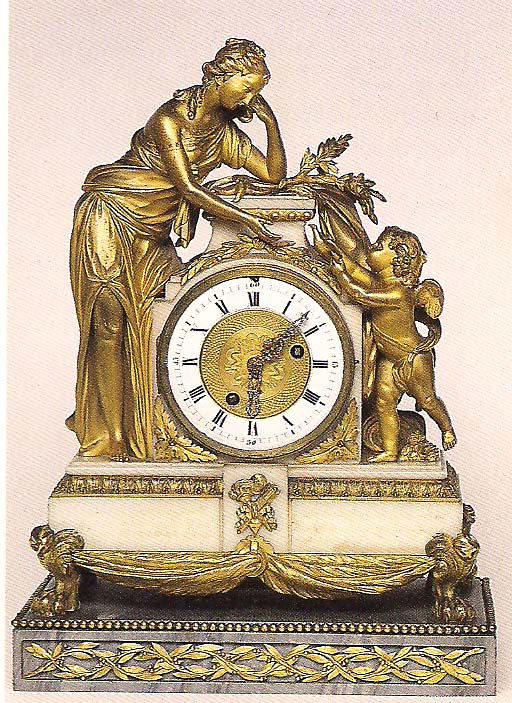
After the 1765 discovery of limousin kaolin at Saint-Yrieix, France was able to produce hard-paste porcelain, such as this garniture by Niderviller consisting of a clock and a pair of vases, circa 1785

This very unusual table en chiffoniere was made by Jean-Henri Riesener and delivered in 1788 for the cabinet interieur of Queen Marie-Antoinette at Saint-Cloud.  Although a trough-shaped top with a high edge indicates its use as a sewing table, the drawer with a leather lid and a silver-plated pen holder also makes it a writing table.
The ebeniste Adam Weisweiler became a master in 1778 and was a favored supplier of the French and English aristocracy.  Rather than using marquetry for decoration, gilt bronze was usually enmployed, as seen in this dessert console.  The marble shelves are backed by mirror and the piece is set against a shallow mirrored niche in the Dining Room.
The leather desk armchair by Jean-Rene Nadal l'Aine was delivered in 1775 for the cabinet interieur of Count d'Artois at Versailles.  (Louis XVI's younger brother, born 1757, survived the Revolution to become Charles X in 1824).
The pair of voyeuses (conversation chairs) in the Grand Bureau were part of a set of four that were commissioned from Jean-Baptiste Claude Sene for the Salon Turc, the game room of the king's sister Madame Elisabeth, in her small Chateau de Montreuil in Versailles.  The grey and white rechampi finish has survived, but the original fabric, with a design of flowers and palm trees on a white ground, has not.
Although the maker of the clock in the count's room is not known, it is a famous model with both Marie-Antoinette and Count d'Artois owning copies.  Known as a clock a l'oiseau (with a dead bird), circa 1780, of chased and gilt bronze, white and blue marble, it is notable for the hands coverd in diamonds.
The exception gilt bronze chandelier in the Grand Salon is attributed to Francois Remond, a favorite supplier of both Marie-Antoinette and the Count d'Artois.  Believed to have originated from the Royal Household, Napolean presented it to the Arch-Chancellor of the Empire for his Parisian residence in 1808.
Little is known of the three-legged center table in the Grand Salon bought from Seligmann in 1900.  Made of chased and gilt bronze with Sarancolin marble, it dates from the end of the 18th century.  A detail of one of the three griffins on the base is shown in the first image.
A pair of circa 1780 vases carved from petrified wood and entwined with chased gilt bronze serpents decorated the cabinet interieurs (most private rooms) of Marie-Antoinette.  In 1789, at the beginning of the Revolution, the queen entrusted her collections of precious objects to Dominique Daguerre, the marchand mercier who had been in partnership with Simon-Phillipe Poirer before assuming the business.  (In 1778, Daguerre had moved to London where he was responsible for Carlton House and Brighton Pavilion decoration).  In 1793, shortly after the execution of Marie-Antoinette, the whole lot was returned to the Nation.  The Directoire put these vases up for sale, with some other objects, in 1798.  And they were known to be sold again in 1841 before joining Count de Camondo's collection.
The silver tureen and try commissioned by Catherine II for Gregory Orloff, 1770/71, was made by Jacques-Nicolas Roettiers de La Tour.  The Soviet government dispersed the magnificent vestiges of the Russian court in the late 1920s and the Count de Camondo was able to acquire several pieces from the same French-made service.
A two-handled milk goblet and its saucer, dating from 1753, are a remarkable example of Manufacture de Vincennes, founded in 1738 to compete with Meissen.  In 1756, the manufacture moved to Sevres, where it remains today. 
This detail shows the Manufacture de la Savonnerie carpet, circa 1740, in the Grand Salon.  Part of the set of ninety three commissioned by Louis XIV for the Grande Galerie of the Louvre, this one, the fiftieth of the series, represents the "Allegory of Air" with four heads representing the winds blowing into trumpets.
The folding screen was an important element in 18th century interior decoration, deflecting drafts and making large rooms more cozy.  This Manufacture de la Savonnerie folding screen of six panels, circa 1735-1740, was made in the older style with tapestry on both faces.  Later screens had crimson cloth on the obverse.
The "Bust of a Black Woman" presented in the Dining Room was acquired in 1932.  About 1781, Houdon was commissioned to create a fountain for Folie Monceau representing a black woman, executed in lead, pouring water on the shoulders of a bather of white marble.  During the revolution, the figures were lost, with the bather eventually being acquired by the Metropolitan Museum in New York.  Houdon had kept a plaster bust of the black woman, however, and later used it in an allegory celebrating the emancipation of the black slaves.  This patinated bronze bust bears the inscription that it was cast by Thomire after Houdon.
"The Shepardess in Love" is one in a series of seven oil on canvas panels and two overdoor panels by Jean-Baptist Huet purchased by Count de Camondo in 1900.  Painted in the second half of the 18th century, the lot came from the Chateau of Benguet, near Mont-de-Marsan. A third overdoor panel, dated 1776, was acquired in 1927, but nothing is known of its provenance.
Bronze played an increasingly important role in furniture in the last third of the 18th century as evidenced by this silver-plated and gilt bronze console with green Egyptian marble.  Designed by Victor-Louis, it was delivered to the royal palace of Warsaw in 1766.
The footstool, circa 1780, was made by Georges Jacob.
The small genre oil painting "Bad Tidings", 1740, by Jean-Baptist-Marie Pierre reflects the love that the Count de Camondo had for the 185h century decorative arts and the representation of the touching reality of everyday life. 
Most of the factual information and all the photos presented in this essay come from the 1991 book The Nissim De Camondo Museum available through The Devoted Classicist Library here.

Thursday, August 11, 2011

Camondo, Paris

The Entrance Court of the Nissim De Camondo Museum, Paris.
The Devoted Classicist is sometimes asked to recommend a "secret" place in Paris that can be visited.  As an instructor for a course at Parsons Paris that I developed where all the class sessions were held at historic sites, I took my students to a number of locations not regularly open to the public.  But one of the most rewarding venues requires no special permission, and yet it is not frequently visited by tourists.  The Nissim De Camondo Museum, part of the Musees Et Monuments De France, is an extraordinary destination for all those interested in the decorative arts.
The original construction drawing for the garden facade.

When Count Moise de Camondo inherited the Napoleon III style family home at 63 rue de Monceau in 1910, he razed it and spent the next three years working with architect Rene Sergent to create a residence as a suitable setting for his collection of mostly Louis XVI period furnishings.  The purchase of period boiserie in 1911 determined the height of the windows, and certain pieces of furniture and tapestries warranted special architectural detailing to accommodate them.  While some of the decorative door and window hardware was collected as antique, reproductions were made as needed.  The staircase balustrade was executed in partly gilt wrought-iron by the Bagues firm after the original at the Hotel Dassin in Toulouse.
The prinicpal floor plans of the Nissim De Camondo Museum, Paris.
As currently interpreted, it is not a house museum in the usual sense.  Originally, reproductions were some times employed until the desired antique was acquired.  When the museum was opened, any contemporary pieces added for utility and/or comfort were removed, and the contents are displayed for viewing rather than to reflect a residential arrangement.  So it takes a little imagination to see it as someone's home, and these images show some of the furnishings relocated for a better camera angle.  But it is a remarkable museum experience, none-the-less, and a great treat to visit as it is almost deserted on a typical summer weekday when other museums like the Louvre are packed.

The main staircase, the Nissim De Camondo Museum.
Some highlights of the collection will be presented in the next post, but here is a survey of the principal rooms.

The Grand Bureau, the Nissim De Camondo Museum.
The provenance of the oak boiserie of the Grand Bureau is not known.  The Aubusson tapestries depict the "Fables of La Fontaine" after Jean-Baptiste Oudry.

The Grand Salon, the Nissim De Camondo Museum.
The white and gilt boiserie in the Grand Salon or Salon Dore comes from a townhouse at 11 rue Royale.  The seating suite by Jacob is upholstered with Aubusson tapestries.
The Salon Huet, the Nissim De Camondo Museum.
The Salon Huet is named after the famous series of paintings by Jean-Baptiste Huet depicting an arcadian romance.  The white marble chimneypiece come from the Hotel Jean-Joseph de Laborde, rue Lafitte, Paris.

The Dining Room, the Nissim De Camondo Museum.
The boiserie of the Dining Room in green rechampi (meaning glazed in various tones) is partly 18th century.


The Petit Salon, the Nissim De Camondo Museum.
 The walls of the Petit Bureau are upholstered in a cerise stripe-on-stripe fabric, a replacement of the original in the late 1980s restoration.

The Bedroom of the son Nissim, the Nissim De Camondo Museum.
The bedroom of the son Nissim de Camondo features a portrait of his grandfather of the same name and a steel and gilt bronze bed, circa 1790-1795.

The Bedroom of Moise, the Count de Camondo.

The view of the Count's bedroom shows a circa 1775 chest by Mathieu-Guillaume Cramer and a circa 1780 armchair a la reine by Georges Jacob.
The Library, the Nissim De Camondo Museum.
The Library of oak boiserie looks down on a private garden adjacent to the house and Parc Monceau beyond.
The Salon Bleu, the Nissim De Camondo Museum.
The Salon Bleu was formerly daughter Beatrice's bedroom.  The color of the silk on the walls is called "the queen's hair".
Sister and brother, Beatrice and Nissim de Camondo, 1916.
Both Moise de Camondo and his wife Irene Cahen d'Anvers were from prominent Jewish banking families.  When they divorced in 1901, the Count was granted custody of their two children, Nissim, born in 1892, and Beatrice, born two years later.  Nissim was a fighter pilot in World War I and was killed in action in 1917.  The death meant the end of the Camondo name.  Perhaps influenced by his cousin Isaac's bequest of his collection to the Louvre which was dispersed among three other museums, Moise's will left the house and the furnishings to the Musee des Arts Decoratifs, to be kept together as a collection bearing the name of his son Nissim de Camondo.  The museum opened in 1936 after the Count's death in 1935.  Beatrice, who had married composer Leon Reinach in 1918 and had two children, inherited a large fortune on her father's death.  But she and her familiy were forcibly taken from their home during the German occupation of Paris, and were killed in the Auschwitz concentration camp in 1944.

All the color photos and the floor plans shown come from the 1991 book The Nissim De Camondo Museum published by the Musees et Monuments de France and sold in the museum bookstore as a guide to the collection. Both English and French versions of the book can be purchased here.

Sunday, August 7, 2011

Aaron Shikler Portraits


The portrait of the Engelhard parrot Jacob by Aaron Shikler.
 Noted portrait artist Aaron Shikler, born 1922, was a personal friend of Charles and Jane Englehard who were profiled in my June 6, 2011, post here with some of the contents from their house Cragwood featured in my June 21, 2011, post here.  The portrait of Sister Parish with her dog Yummy in the previous post of The Devoted Classicist reminded me of the portrait I admired so much of the Engelhard's parrot, Jacob.  While Jacob's portrait was included in the sale of the contents of Cragwood, the Shikler portrait of Mrs. Engelhard was not.  Beginning with a 1959 breakthrough commission, Jane Engelhard became a major patron of Shikler, eventually commissioning the Lady Bird portrait, one of Mike Mansfield for the U.S. Senate, and another of the Duchess of Windsor, among others.

Portrait of Mrs. Charles W. Engelhard, Jr. by Aaron Shikler.
 Aaron Shikler studied at The Barnes Foundation in Marion, Pennsylvania and at the Tyler School of Art, Temple University in Philadelphia with a stint in Europe between serving as a map-maker during WWII.  Returning to New York in 1949, he worked in the studio of Hans Hoffman, the Abstract Expressionist.

Portrait of John Kennedy, Jr., by Aaron Shikler.
Whether the recommendation came through her friend Jane Engelhard is unknown, but Jacqueline Kennedy commissioned the artist to do a portrait of young Caroline and John Kennedy in 1968, followed by others of Mrs. Kennedy alone and the three together.


Portrait of Jacqueline Kennedy by Aaron Shikler.
 Appreciating his artistic style and ability to please the client, Mrs. Kennedy asked Shikler to paint her official White House portrait, perhaps the most memorable of all the First Lady portraits.

Preliminary study for official White House portrait of First Lady Jacqueline Kennedy by Aaron Shikler.

A view of the White House Vermeil Room during the Reagan Administration showing the Aaron Shikler portrait of First Lady Jacqueline Kennedy above the settee to the left.
Photo from DREAM HOUSE, THE WHITE HOUSE AS AN AMERICAN HOME by Ulysses Grant Dietz and Sam Waters, Acanthus Press, 2009.
Shikler also painted the White House portrait of President John F. Kennedy, with Mrs. Kennedy's guidance.  She stipulated that there were to be no bags under his eyes and no penetrating gaze.

A 1962 sketch of President John F. Kennedy by Aaron Shikler from the Engelhard collection at Cragwood.
After producing a number of sketches for consideration, Mrs. Kennedy chose the pose with folded arms and lowered head that was adapted from a photo of Ted Kennedy in a similar stance at JFK's grave.  While it was controversial as some said the unconventional pose was not appropriate for the White House setting, many have found the portrait moving.

The official White House portrait of President John F. Kennedy by Aaron Shikler.
 Other White House portraits for President Lyndon B. Johnson, President Ronald Reagan, and First Lady Nancy Reagan followed.  A 1981 article in People magazine stated his then-current fee started at $25,000 for a head and shoulder portrait and $35,000 for for a full figure portrait.  A portrait of Jordan's Queen Noor was $140,000, however.   He no longer allowed input from the sitter, the story said, after an experience with the subject feeling the image was not flattering enough.

Thanks go to P. Gaye Tapp at the wonderful blog Little Augury for directing me to the blog Privilege.  Shikler also painted a portrait of the blog author Lisa, her brother, and her sister which can be seen here.

The display of portraits seems to have fallen out of favor these days in residential decoration, but do you not think there is a place for good portraits in stylish interior design?


The 2009 book Dream House, The White House as an American Home is available for purchase at a discount from the published price and the option of free shipping through The Devoted Classicist Library by clicking here.

Monday, August 1, 2011

New Twist On Sister


A portrait of Sister Parish with her Pekingese, Yummy, by Aaron Shikler.
From Parish-Hadley, Sixty Years of American Design by Christopher Petkanas, 1995.
 There is a new book about my former employer, the legendary decorator Sister Parish, which will be available in the U.S. in November, 2011.  Dorothy May Kinnicutt (whose year of birth is often listed as 1910, but sometimes earlier), was dubbed "Sister" by her brothers and the name stuck even after she became Mrs. Henry Parish, 2nd.  In the Olden Days, when members of High Society were often in the newspapers only three times -- birth, marriage, and death -- Sister Parish quietly decorated the homes of the Rich for thirty years before becoming nationally known.  A newspaper headline announced "Kennedys Pick Nun to Decorate White House" when she joined the committee to contribute to the highly publicized redecoration of the Executive Mansion.  Bringing on Albert Hadley, the business partnership became Parish-Hadley for another thirty years, and the office continuing on several more after Mrs. Parish's passing in 1994.
The Guest Room at Greentree known as the Princess Margaret bedroom.
From Parish-Hadley, Sixty Years of American Design by Christopher Petkanas, 1995.
While it would be hard for The Devoted Classicist to name a favorite Parish-Hadley project, the sprawling mansion on the Greentree estate is certainly the most memorable.  One of several lavish residences of John Hay "Jock" Whitney and his second wife Betsey of the famous Cushing sisters (formerly married to FDR son James Roosevelt, her sister Minnie was once married to Vincent Astor and her sister Babe was married to Standard Oil heir Stanley Mortimer, Jr., before marrying CBS founder William Paley), the estate was created starting in 1904 with the purchase of five contiguous farms by Mr. Whitney's father, Payne Whitney, stretching across the entire width of Long Island from sound to ocean.  The original colonial farmhouse was expanded to become an enormous mansion, filled with exquisite art and made exceptionally comfortable with the help of Parish-Hadley and a sizeable household staff.  When Jock Whitney, Thoroughbred horse enthusiast and one of the wealthiest men in the world, was named by President Eisenhower as the Ambassador to the Court of St. James, the Whitneys became close friends of Queen Elizabeth II and Prince Philip, as well as the other members of the royal family.


Copyright 2011 Frances Lincoln Ltd.  Author:  Martin Wood.  $60.00.
 It is not surprising that the guest bedroom at Greentree known as the Princess Margaret bedroom is featured on the cover of the new book by Martin Wood, as it is very representative of the style of Sister Parish, comfortable and without ostentation despite the elements of formality and the huge house.  The story of the redecoration of the room for the private visit by the Princess and Lord Snowden after their highly publicized 1960 wedding is told with photos in both books Parish-Hadley, Sixty Years of American Design and Albert Hadley, The Story of America's Preeminent Interior Designer.  A private suite of two bedrooms, a bathroom, and a sitting room was formed from a line of rooms, creating a passage through a former closet to connect the bedrooms withoug disturbing the existing nineteenth century French scenic wallpaper.  Tone-on-tone Swiss muslin curtains with tassel fringe paired with natural linen roller shades trimmed with Irish lace dress the windows with a matching treatment for the dressing table holding a triptych mirror and a pair of bronze candlestick lamps in the form of a palm tree sheltering a giraffe.  A carpet of a small geometric pattern is scattered with a number of antique hooked rugs, a favorite Sister Parish touch.  There is no use of chintz here, considered a trademark, but the bed with a custom shaped headboard upholstered with cotton matelasse is covered with a boldly graphic American quilt, quintessentially Mrs. Parish.

The publication of this new book is greatly anticipated as the Sister Parish style of decorating is still popular today.  The chapters start with "Where It All Began" and continue to "Twilight", plus a Bibliography, Notes, and an Index.  The author Martin Wood is known for his widely acclaimed previous design biographies, John Fowler: Prince of Decorators and Nancy Lancaster:  English Country House Style which showcase the forces behind the legendary London interiors firm Colefax & Fowler.


In affiliation with Amazon, the Sister Parish, Albert Hadley, and Parish-Hadley books are available through The Devoted Classicist Library here.   The books on John Fowler, Nancy Lancaster, and Colefax & Fowler are available here.

Thursday, July 28, 2011

Staircase Renovation

The renovated stair with a new balustrade by John Tackett Design compliments the original style of the house.  The custom stencilled decorative painting was executed by the late Robert Jackson and his crew.
Photo by Pieter Estersohn.
As a continuation of the series of posts on the house in Volk Estates, University Park, Dallas, the improvements for the main staircase in the Entrance Hall are presented here.  Although the house was built in the Tudor Revival style in 1934, it had been remodelled in the 1950s with many of the original details replaced by more modern and eclectic features.  The Fifties iron stair balustrade was the first thing noticed on entering the house, and it was the feature at the top of the list that the new owners were most eager to change.
A BEFORE view of the Fifties balustrade showing the new oak handrail.
Photo by John Tackett Design.
New wood balusters, newel and handrail were designed to compliment the architecture and comply with safety requirements.  The curve of the stairs was continued above, with the floor opening altered and a curved second floor partition added to redefine the space.
An IN PROGRESS view showing the new balustrade and the altered floor opening to continue the curve.
Photo by John Tackett Design.
These changes led to a reconstruction of the entrance to the second floor bedroom located above the main entrance.  Although the bedroom had an attractive triple exposure, the original locations of the doors prevented a comfortable placement of furniture.  The new plan proposed by John Tackett Design shown below was realized, relocating the entrance to a large walk-through closet that also provided acess to an adjacent second guest bathroom and guest bedroom (not shown).

The Proposed Plan of the renovated second floor Stair Hall and the Guest Bedroom.
Drawing by John Tackett Design.

On the exterior, the unique original oriel window of Douglas fir, copper, and leaded glass placed against the exterior wall of random Texas fieldstone and diaper-patterned brick makes the house memorable.  The original architect was Clyde H. Griesenbeck, noted for his picturesque Tudor manors in both University Park and adjacent Highland Park.

An Exterior view of the main entrance with the Guest Bedroom above.
Photo by Steve Clicque from THE HOMES OF THE PARK CITIES, DALLAS:  GREAT AMERICAN SUBURBS.


The 2008 book THE HOMES OF THE PARK CITIES, DALLAS:  GREAT AMERICAN SUBURBS may be purchased through The Devoted Classicist Library at a discount of 37% off the published price and the option of free shipping by clicking here.

Friday, July 22, 2011

The Travellers: Albert Hadley and a Sunburst Clock

Photo by Michael Mundy for Parish-Hadley.
In the Horse Country of New Jersey, the area around Peapack where the owners of the beautiful old estates still insist on keeping their roads unpaved, was a very stylish house with a great room, perhaps my favorite of the Parish-Hadley living rooms done before my time there. 

Photo by Michael Mundy for Parish-Hadley.
Ornamented with classical pilasters salvaged from a local historic building, the pale gray walls and the dark-stained wood floor provided a great background for the furnishings in essentially just three fabrics:  a chintz, a silk, and a cotton.  Decorated in 1969, the room remained virtually untouched until the owner decided to scale down to a smaller house forty years later.  Albert Hadley was called back to edit and arrange the furnishings, one of my favorite being the giltwood starburst clock.

Photo by Simon Watson for "House Beautiful".

In the new house, a very simple clapboard Late Georgian dating to 1820, the two front rooms were combined to create a large living room with a fireplace at each end.  The walls were painted off-white again, but this time the wood floor was painted pale gray, a custom mixed color Albert Hadley calls Fog, and again left bare.  The chintz-upholstered Odom chairs were placed flanking the fireplace; the chintz had been discontinued so it was not replaced.   Other seating was slipcovered or recovered, however, with the exception of the great pair of Regency benches which still remained without refreshment of the painted finish.  The wooden urn lamps that had white shades when placed in front of the wallpaper screens in the former house, now have black shades to stand out at the bare windows.

Photo by Simon Watson for "House Beautiful".
This room is an example of decorating small, spare and chic.  And it cannot be said often enough:  buy what you love and it can be used over and over again.
The 1969 decoration appeared in Parish-Hadley, Sixty Years of American Design with photos of this room by Michael Mundy, and the new house with re-used furnishings was featured in the July, 2009, issue of "House Beautiful" magazine with photos by Simon Watson.


The 1995 Christopher Petkanas book PARISH-HADLEY, SIXTY YEARS OF AMERICAN DESIGN is out of print, but used and collectible copies can be purchased through The Devoted Classicist Library in affiliation with Amazon by clicking here.

Sunday, July 17, 2011

A Very Impressionistic Summer


A Renoir painting currently on exhibition at the Memphis Brooks Museum of Art.
Pierre-Auguste Renoir, French, 1841-1919.  Woman Arranging Her Hat, ca. 1890.  Oil on Canvas.  High Museum of Art.  Gift of Micheline and Bob Gerson.  2008.165.
 Those who are able to tolerate this summer's heat in Memphis are rewarded with not one but two extraordinary exhibits of Impressionist art.  These images that are now so popular and so easy-on-the-eyes were once considered not only avante garde but shocking, and eventually revolutionized the way we look at art.
At the Memphis Brooks Museum of Art, Monet to Cezanne/Cassatt to Sargent:  The Impressionist Revolution, the exhibit curated by Stanton Thomas, Curator of European and Decorative Arts, features over 100 paintings and works on paper as a collaborative effort by the High Museum of Art in Atlanta with the Brooks, with works also from the Dixon Gallery and Gardens, Memphis.  These three important collections of French and American Impressionism and Post-Impressionism feature works from many of the masters spanning the 1850s through the 1920s.  For more information click www.brooksmuseum.org/
A Forain pastel on exhibit at Dixon Gallery and Gardens.
Jean-Louis Forain, French, 1852-1931.  In Front of the Set, ca. 1895-1900.  Pastel on Paper.  Collection of the Dixon Gallery and Gardens, Museum purchase with funds provided by Brenda and Lester Crain, Hyde Family Foundations, Irene and Joe Orgill and the Rose Family Foundation, 1993.7.30.
Also in Memphis, the Dixon Gallery and Gardens is presenting the exhibition Jean-Louis Forain:  La Comedie parisienne, organized and produced with the Petit Palais, the Museum of Fine Arts of the City of Paris.  It is a landmark retrospective of Jean-Louis Forain (1852-1931), a member of the Impressionist circle, protege of Degas, and mentor to Toulouse-Lautrec.  Assembled from museum and private collections world-wide, 130 paintings, pastels, drawings, lithographs and mosaics trace the artist's career over a fifty year time period.  For more information click www.dixon.org/

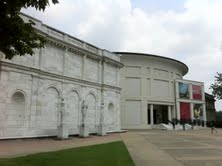
Memphis Brooks Museum of Art, with the original building by James Gamble Rogers on the left.
Photo by John J Tackett for The Devoted Classicist.
Regular readers of The Devoted Classicist will recall the essay on the original part of the Brooks Museum designed by New York Architect James Gamble Rogers featured in the May 31, 2011, post.  As a special feature of this remarkable pair of exhibitions, a General Admission ticket purchased at Brooks can be presented at Dixon for free admission, and vice-versa.  Brooks is closed on Mondays and Tuesdays, but Wednesdays are Pay-What-You-Can.  Dixon is closed on Mondays, but Tuesdays are Pay-What-You-Can and Saturdays are free from 10 to noon.  (These free admissions are corporate sponsored with private funding contributions).


Dixon Gallery and Gardens, with the original house by John F Staub on the right.
Photo by John J Tackett for The Devoted Classicist.
The original part of the Dixon is a handsome house that was designed by Tennessee-native John F. Staub, best known for his work in Houston.  The Dixon residence will be featured in an up-coming essay on The Devoted Classicist.