Showing posts with label Mildred and Charles Allen Jr. Show all posts

Thursday, November 24, 2011

The Furnishings: Mr & Mrs Charles Allen Jr

The Salon.
Photo by Sotheby's from JANSEN by James Archer Abbott.

As Part Two of the previous post of The Devoted Classicist, "Notable Homes: Mildred and Charles Allen Jr at 2 East 67th Street", this takes a closer look at the specific furniture and the interior design by Stephane Boudin of Maison Jansen, the legendary Parisian decorating firm.  As necessary, click on the link to go back to see an overview of the apartment building and a typical floor plan.

The Entrance Hall Gallery was not pictured in the catalog other than a glimpse in this mirror over the fireplace shown below.  In JANSEN, author James Archer Abbott describes the space as having doors made in the Paris ateliers of Maison Jansen with the double doors (as seen in the reflection) having plain surrounds, but the single doors having pediments of mirrored glass and gilt-bronze trelliswork.  Also added by Jansen was a white marble chimneypiece and the new ceiling with a lighted recessed oval;  the supply grilles for the central air-conditioning in all the major rooms were carefully considered and this ceiling most certainly concealed the ductwork.
A Louis XVI style giltwood mirror. Withdrawn from the sale.  Note the six mirror plates in three sizes and the two pins.
A pair of Louis XVI painted and parcel-gilt chaises en cabriolet, last quarter 18th century, upholstered in contemporary tapestry.  Bearing the stamp, G. Iacob.  Sold $11,500.

The Salon was located at the corner of Fifth Avenue and East 67th Street overlooking Central Park and panelled with fragments of 18th century boiserie with new elements made by Jansen as required to fill out the space.  Just as remarkable as the woodwork itself was the paint finish, a watery antique green sometimes called "Eau de Nile" with the mouldings picked out in ivory.  In the book JANSEN, the author relates that former Versailles curator Gerald Van der Kemp told him that the green was Boudin's favorite color for a room.
The Salon.
Photo by Sotheby's from JANSEN by James Archer Abbott.

The Salon.
Note that the color of the panelling is not reproduced accurately.
Photo by Sotheby's from JANSEN by James Archer Abbott.


A fine Louis XV ormolu-mounted table a livre et a ecrire of mahogany, tulipwood, sycamore, and fruitwood marquetry.  Mid-18th century, signed L. Boudin.  The top with a three-quarter greek key pierced border slides back in conjunction with the frieze drawer to reveal a velvet-lined reading stand rising on a rachet.  Sold $310,500.
A set of four Louis XV fauteuils a la reine, mid-18th century, signed A. Criaerd, JME, are a point of discussion in the book JANSEN.  Mrs. Allen wrote in a letter to the head of the firm Stephane Boudin that she was disappointed in the upholstery and the finish when the shipment arrived from Paris, having been told by someone in New York that the chairs had stripped of their original painted or gilt finish.  Boudin replied that it was not the case, but that the original painted finish had been touched up in the Jansen workshop to cover wear and to coordinate with the paneling.  The fabric was "as is" to avoid customs duties and would be replaced with the final fabric in New York.   And he added that he was very interested in pleasing his favorite client.  Apparently, any doubts were qualmed as the finish appears to be very much as one would expect from Jansen.  Sold $40,250.
A pair of Empire style ormolu and marble gueridons.  Sold $50,100.
A fine pair of Louis XV/XVI giltwood fauteuils a la reine, third quarter 18th century, signed Tilliard.  Formerly in the collection of the late Thelma Chrysler Foy.
An assembled collection of St. Cloud and Chantilly porcelain was displayed on shelves in lighted recessed niches flanking the fireplace.  The reproduction of color and light is a little off in the printing, showing a more vibrant melon color that would have been true in reality.
A fine and rare Louis XV bureau plat of ormolu-mounted tulipwood, purplewood, and bois satine marquetry.  Mid-18th century, signed B.V.R.B., the mounts bearing Crowned C marks (a tax mark struck on any metal incorporating copper between March 1745 and February 1749). This is nearly identical in size to the bureau plat also by Bernard II van Risamburgh that is covered in ebony veneer in the Wrightsman collection.  Sold $332,500.
A pair of Louis XV giltwood chaises en cabriolet, mid-18th century, signed L. Mayeux.  Sold $10,350.
A fine pair of Meissen 'Mayflower' vases mounted in Louis XV ormolu circa 1745, the mounts bearing the Crowned C mark.
A rare Meissen white oval verriere mounted in German Baroque ormolu circa 1740, formerly in the collection of Thelma Chrysler Foy.
A Regence giltwood tabouret, the underside of the stretchers struck with the letters CO.
A Louis XV style eight-light chandelier of ormolu, rock crystal and cut-glass.  Sold $12,650.
As attractive as the Salon was, the Dining Room was even more spectacular.  The simple Louis XVI panelling for the almost-square room was antique, featuring decorative medallions incorporated into the design.  It was the fantastic paint finish, expertly antiqued in two shades of light blue and old white, that marked the success of the space, however, and provided such a brilliant background for the painting of waterliles by Monet, planned for the north wall opposite the fireplace from the beginning.
The Dining Room.
A Louis XVI extension dining table of gilt-metal-mounted mahogany, with three additional leaves, brass casters.  Sold $57,500.
A set of twenty-two Louis XVI style chaises en cabriolet painted white.  Made in the Jansen workshop in Paris.  Sold $17,250.
A Louis XVI style console, painted grey, with a grey and white mottled marble top.  Sold $6,900.
A pair of George III two-light candelabra of ormolu-mounted porcelain and cut-glass, late 18th century.
A Louis XVI console, painted gray with a gray and white mottled marble top, last quarter 18th century.  Sold $9,200.
This photo reveals the simple but effective paneling and paint scheme.  Also note the duplex electric outlet placed horizontal in the baseboard, almost always the best location for typical placement.

The Library was lined in new Louis XVI style panelling painted a buttery yellow to coordinate with the antique yellow and white chimneypiece, both supplied by Jansen.
The Library.
A Louis XVI table a ecrire of ormolu-mounted ebony and pewter, last quarter 18th century, signed L. Moreau.
A Baltic neoclassical ten-light chandelier of gilt-metal, green glass and cut-glass, late 18th century.  In the book JANSEN, author James Archer Abbott notes that Stephane Boudin personally chose this chandelier for the space.  Sold $27,600.
A Louis XVI style giltwood mirror.  Note the divided mirror plate as a period antique would have had.  Curiously, this room was not designed to have an integral mirror incorporated into the paneling like the Salon and Dining Room, but instead utilized this piece as if it were a fragment of antique paneling.
A Japanese lacquer low side table, the tray-form top raised on shaped bracket supports.  Although the maker was not listed, this is typical of the accessory furnishings that were made by the Maison Jansen workshops that incorporated older fragments to provide supplements to the antiques.

A Louis XVI small painted canape last quarter 18th century.  Sold $10,300.
Secondary furnishings such as modern upholstery were not included in the sale.  Nor were carpets;  Boudin would have certainly supplied either antique rugs or handmade reproductions for these principal rooms. 

The art from the Allens' apartment was sold in three separate auctions according to the appropriate category:  Important Old Master Paintings, Old Master Drawings, or Impressionist & Modern Art.
A pair of oil on canvas paintings Bathers at Fountains in Pastoral Landscapes, Jean-Baptiste Pater.
Two of a set of four pen and ink and watercolor on paper drawings, Chinoiseries, three signed and dated Jean Pillement 1771.
Oil on canvas, Nympheas, Claude Monet.
Unless noted otherwise, all the images are from the Sotheby's sales catalog THE ESTATE OF MRS. CHARLES ALLEN JR. for the auction that was held November 1, 1997, in New York, Sale 7077 "ALLEN".  Upcoming sales can be previewed on-line at their website. 

The book JANSEN by James Archer Abbott was published by Acanthus Press, New York, 2006.  It may be purchased at a discount with the option of free shipping through The Devoted Classicist Library.

Monday, November 21, 2011

Notable Homes: Mildred and Charles Allen Jr at 2 East 67th Street

The Salon, as shown for the 1997 auction.
Photo:  Sothebys.

Here is another in The Devoted Classicist "Notable Homes" series.  This time, we take a look at a Manhattan apartment decorated from 1959 through the 60s by the legendary Parisian firm Maison Jansen, beginning under the guidance of Stephane Boudin.  The limestone building, located at the corner of Fifth Avenue and East 67th Street, was built 1927-8 with an all-star design roster of Warren & Wetmore, best known as the architects of Grand Central Terminal; Rosario Candela, widely considered the best designer of classic luxury 1920s apartment buildings; and Shreve and Lamb, of the Empire State Building fame, as consulting architects.  As an additional consultant to the building, there was Mrs. George Draper, the wife of FDR's physician who would later divorce and become famous as the decorator Dorothy Draper.
The apartment building, 2 East 67th Street, Manhattan.
Photo:  Museum of the City of New York.

Originally, the building had nine full-floor simplex apartments having 14 rooms, two duplex maisonettes, and a penthouse duplex of 18 rooms.  In the 1940s and 50s, there were a few divisions, but it still remains an exclusive and desirable address.  The building replaced the townhouse of Judge and Mrs. Elbert H. Gary which occupied the site for only 15 years as 856 Fifth Avenue.  The widow Gary bought an apartment in the new building, typical for the time as the convenience of apartment living was widely promoted.  After a lengthy legal battle with the owner of the neighboring townhouse, former Governor Nathan Miller, over who had the rights to the address 2 East 67th Street, the developer Michael Paterno won.  Still today, these No. 1 and No. 2 side street addresses are more desirable among many as a distinction between the Knowledgeable and the Newcomer.
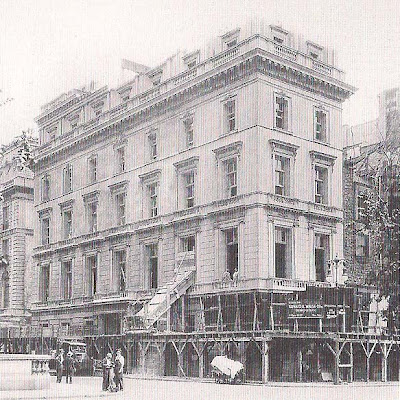
Judge Gary's townhouse at the time of demolition.
Photo:  The Museum of the City of New York.

Over the years, there have been some record-breaking sales in the building.  In 2008, Jonathan Tisch, b. 1953, the co-chairman of his family's multi-billion dollar conglomorate, the Loews Corporation, reportedly paid $48 million for the 11th floor apartment;  at that time, it was a New York co-op apartment record.  The listed price was $40 million, however.


Charles Allen, Jr., 1903-1994, dropped out of school at age 15 to become a runner on the New York Stock Exchange.  In 1933, he founded Allen & Company, an investment firm that bought up huge blocks of stock in companies at bargain prices during the early days of the Depression.  Later, the firm provided the initial capital for many companies such as Syntex Corporation, which developed oral contraceptives and anti-inflammatory drugs, the the Teleregister Corporation, a pioneer in on-line computer systems.  He helped developed Irvine Ranch in Orange County, California, in addition to oil and mineral developments in Libya, Algeria, Morocco, and Mauritania, gold mines in the Philippines and the Grand Bahama Port Authority in the Bahamas.  He was also a director of many major American companies including Pepsico, the Ogden Corporation, CF&I Steel Corporation, Warner Brothers, and the Ambac Corporation.  He had two sons and daughter, the successful Broadway producer Terry Allen Kramer, with his first wife, Rita Allen who was also a noted theatrical producer;  that marriage ended in divorce.  Little is known of his second wife Mildred, 1908-1997, except that she was preceeded in death by her son Arthur from a previous marriage, and that she had a keen sense for design and decoration.  Born Mildred Gottlieb, she had been married to Arthur Arndt and to Marc Haas, the noted stamp collector.  At the time of Charles Allen's death, they were separated, with his living at the Sherry-Netherland.
Mildred Haas Allen.
Photo:  JANSEN by James Archer Abbott.

In Part Two, we will take a look at the Jansen decoration of the principal rooms and a closer study of the furnishings. The historic photos of 2 East 67th Street come from THE NEW YORK APARTMENT HOUSES OF ROSARIO CANDELA AND JAMES CARPENTER by Andrew Alpern available for purchase at discount here.  Much of the background information on Mr. and Mrs Charles Allen, Jr., comes from the highly-recommended book JANSEN by James Archer Abbott;  additional information and photos can be seen in the book available at a discount here.