Showing posts with label The DiCamillo Companion. Show all posts

Friday, October 21, 2011

Old Battersea House

The garden (river) front of Old Battersea House, London.
As a tie-in to the last post of The Devoted Classicist, here is another essay about yet another historic London house and an auction of its contents.  Fortunately, the mansion is still extant this time, and it is for sale.  (The "guide price" is GBP 12,000,000 or about $19 million).  And the contents will be sold with an upcoming auction in Edinburgh, Scotland, next month.  It is regretful, however, that we missed the opportunity to see the lots in situ last weekend when there was a public viewing at Old Battersea House.
The entrance to Old Battersea House.

When it was built, 1699 or even earlier, the Thames riverside property (now separated from the water by a roadway) was surrounded by fields.  Much of the land belonging to the handsome manor house was sold in the 1920s after being vacated by St. John's College, a Church of England college for priests.  Although the architect is unknown, the possibility of being designed by Sir Christopher Wren has been considered as the house does match his style.  The local authority, the Battersea Council, bought the house from the college and would have demolished it and built what we in the U.S. call a housing project had it not been for the public outcry.  An Act of Parliament saved the house from demolition.
A lithograph of Old Battersea House, signed E.F.G. Joy.
Lot 452.
[Sold:  US $279.]

The leaders of the fight to save Old Battersea House were Col. Charles G. Stirling and his wife Wilhemina.  They lived in the house, leased from the Council, starting in 1931 until her death at almost age 100 in 1965.  (The Stirlings' collection of paintings, ceramics, and furniture was bequeathed to the De Morgan Foundation and is on view at the nearby West Hill Library).  But the house fell into disrepair and languished until Malcolm Forbes acquired a 99 year lease in 1971.  (Freehold ownership was later acquired from the Battersea Council).
The Entrance Stair Hall of Old Battersea House.
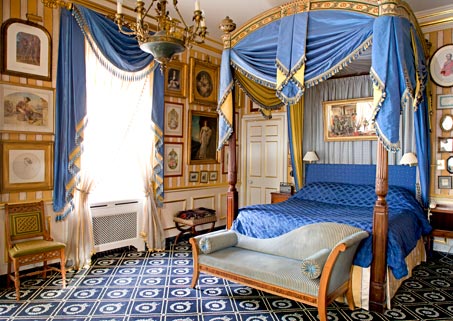
Architect Vernon Gibberd and later, son Christopher "Kip" Forbes, restored the house, adding modern amenities, to serve as the Forbes family's London home as well as housing one of the world's most important collections of 19th century British art.  Elizabeth Taylor was a frequent guest, staying in the (queen size canopy bed, see photo below) Red & White Bedroom, and President and Mrs. Regan once stayed in the (twin beds, see the link to The DiCamillo Companion) Black Bedroom.  (Readers will want to see the video, linked below, to view the Black Bedroom, named for the walls, curtains, and beds all upholstered in flowered chintz with a black background).  The State Bedroom had a display of art in tribute to Queen Victoria;  the adjoining bathroom had a display of the Queen's personal garments.
The State Bedroom of Battersea House.

The State Beddroom with a view to the adjoining bathroom beyond.

Many of the works of art from the Forbes collection that had been displayed at Old Battersea House, along with antiques and furnishings of more recent date, will be sold in the November 1, 2011, auction by Lyon & Turnbull, Sale 338.   Unless otherwise noted, all these images come from their site;  the 508 lots can be viewed on their on-line catalog of the sale here.  A few highlights follow:
Fine South German Limewood Model of a Neo-Classical Palace.
Lot 11.
[Sold:  US $16,740]

The model by C. Herman Bruckner dates from the late 19th century and includes 31 figures of horse-mounted guards, standing guards, dogs, and the home owner with his family and servants.  The estimate is GBP 15,000 - 20,000.
REGINA CORDIUM:  A PORTRAIT OF MRS. ALDAM HEATON.
Lot 70.
[Unsold]

The oil on panel portrait was painted by the British artist Dante Gabriel Rossetti and is dated 1861.  Remarkably, it still has the original giltwood mat and "thumb print" frame designed by the artist.  The estimate is GBP 80,000 - 120,000.
Arts & Crafts Grand Piano.
Lot 140.
[Unsold]

Designed by Charles Robert Ashbee, and made by John Broadwood & Sons, London, circa 1904, this unique piano features patinated brass pierced strapwork Celtic hinges.  The estimate is GBP 12,000 - 18,000.
The Late Victorian Mahogany Four-Poster Bed favored by Elizabeth Taylor.
Lot 338.
[Sold:  US $13,950]

This bed, circa 1880, in the Red & White (Master) Bedroom has red and ivory silk hangings.  The room was favored by Elizabeth Taylor and she spent her seventh honeymoon here with husband Larry Fortensky.  The estimate is GBP 8,000 -12,000.
Queen Victoria's Silk Bloomers.
Lot 414.
[Sold:  $13,950.]

The personal garments are usually destroyed after the Sovereign's death, so these knickers, embroidered in blue with a crown and 'VR2' on the waistband, are the only known survivors.  The estimate is GBP 2,000 - 3,000.
Oil on canvas view of Old Battersea House by Julian Barrow.
Lot 146.
[Sold:  US $1,116]

An excellent video overview of the house and contents was produced for the auction.  The 14 minute highly recommended film is hosted by Curt DiCamillo, an expert on historic architecture and decorative arts as well as a friend of Kip Forbes (and The Devoted Classicist).  It can be viewed here here.  And there is a second video, almost 7 minutes, that features just the paintings that can be viewed here.

The facts of the house's history came from the most informative site, The DiCamillo Companion, and more can be read here.  More about the features of the Grade II listed house today can be found at the site of the real estate agent, Savills, here.

Tuesday, October 18, 2011

The Duke of Devonshire's Lost London House

Last week, when Simon Seligman gave his brilliant talk, "Custodians, Collectors, and Tastemakers:  The Duchesses at Chatsworth", to the members and guests of Decorative Arts Trust (see the October 6, 2011, post), he touched on Devonshire House, the magnificent London home of the Duke of Devonshires that was once the center of the Cavendish family dynasty.  The Devoted Classicist remembered an article from an issue of "Country Life" last year on the occasion of the 'attic sale' by Sotheby's at Chatsworth.  The interior architectural details of the state rooms had been stored in the Chatsworth stables for almost 90 years after Devonshire House was demolished.  Whole rooms were carefully dismantled, labeled, and stored, with the hope that the interiors could be someday incorporated into a new building.
Stephen Colin's illustration of Devonshire House shows how the residence looked before the contents were removed in 1914.  From "Country Life" magazine, August 25, 2010.

Devonshire House was built by the 3rd Duke in 1733-34 on the Piccadilly site of Berkeley House, the 17th century residence that burned the previous year.  The new house with a severe classical brick exterior and grand classical interior was designed by William Kent, 1685-1748, and built on the foundations of the old house.  (Kent was a protege of friend and neighbor, the Earl of Burlington.  The Duke's son later married Lord Burlington's daughter, Charlotte Boyle, and inherited Chiswick Villa a Neo-Palladian masterpiece that was a design collaboration by Burlington and Kent). 
The marble staircase with the unusual crystal handrail disappeared and was the only major architectural feature not included in the auction.
The ground floor contained an Entrance Hall, accessed through a porte-cochere, and service rooms.  The main floor above, a piano nobile, contained eleven lavishly decorated state rooms reached by a spectacular curving marble staircase with a gilt-metal balustrade and a crystal handrail;  this 1853 Empire addition was designed by architect Decimus Burton who was also responsible for the portico.
The Ballroom of Devonshire House.
Two drawing rooms were combined during the occupation of the 6th Duke, using the decorating firm Federick Crace & Son to create a ballroom.
The Saloon of Devonshire House.
The Saloon, on the front of the house overlooking Green Park, was also redecorated by Crace with trompe l'oeil painting on the high coved ceiling above blue and gold silk covered walls with elaborate gilt framed mirrors.
The Dining Room of Devonshire House.
The Dining Room featured portraits within architectural frames incorporated into the paneling.  A robust William Kent console is shown with a later table and chairs dating from the Crace redecoration.
A side view of the Francois Herve settee, one of a pair, commissioned for Chatsworth.
During the occupation of the 5th Duke, the private apartments were remodeled by architect James Wyatt for the house's most famous occupant, the legendary Duchess Georgiana.  The 5th Duchess, 1757-1806, was the undisputed leader of London style, fashion, and society, painted by Gainsborough, Reynolds, and Cosway.  A close confidante of Marie Antoinette, the Duchess shopped in Paris just weeks before the storming of the Bastille.  A set of eleven caned chairs, believed to be similar to the pair of settees from Chatsworth and included in the auction, were commissioned from Francois Herve, the noted Huguenot cabinet maker of the George III period.  (Georgiana was portrayed by Keira Knightly in the 2008 film "The Duchess").

The house was occupied by the Red Cross during the First World War, and sold to a property company in 1919 to help the 9th Duke pay Death Duties of GBP 500,000 plus the debts of the 7th Duke which he also inherited.  But a condition of the sale was that if the house was demolished and replaced by an apartment building of the same name, all the interior architectural details reverted to the Devonshire/Cavendish family.  In 1925, the fittings were carefully dismantled and sent to storage at Chatsworth.  Evelyn, Duchess of Devonshire, oversaw the recording and removals, reinstalling the art at Chatsworth and seeing that the salvaged details of one of London's most famous mansions were preserved. 
Photo of the Devonshire House apartment building by Curt DiCamillo from
The DiCamillo Campanion.

Across from the Piccadilly entrance to Green Park, the entrance gates and sphinx-topped piers are all that remains in place from historic Devonshire House with the exception of the Wine Cellar, now the ticket office of the Green Park Underground Station.  More about Devonshire House can be read here on the remarkable website The DiCamillo Companion.  Curt DiCamillo's site includes a database that is a continuing effort to document every country house in Britain and Ireland, plus, and this is invaluable to this writer, a Pronunciation Guide.
Photo of the current Duke of Devonshire at the exhibition tent for the
Sotheby's Attic Sale at Chatsworth, October, 2010.
In an October, 2010, three day auction which also included items in storage at Chatsworth that were from other Devonshire family properties, almost $10.3 million was raised, selling 20,000 items in 1,400 lots.  The top lot was a circa 1735 marble chimneypiece (similar to this one pictured above) attributed to William Kent which was estimated at GBP 200,000 - 300,000 and fetched GBP 565,250.

The black & white interior photographs were taken by "Country Life" in 1914 before the house was closed and were reprinted, along with the color cut-away illustration, in the August 25, 2010, issue of the magazine.  More information about subscriptions to the magazine can be found at www.countrylife.co.uk/.