Showing posts with label Chatsworth. Show all posts

Tuesday, October 18, 2011

The Duke of Devonshire's Lost London House

Last week, when Simon Seligman gave his brilliant talk, "Custodians, Collectors, and Tastemakers:  The Duchesses at Chatsworth", to the members and guests of Decorative Arts Trust (see the October 6, 2011, post), he touched on Devonshire House, the magnificent London home of the Duke of Devonshires that was once the center of the Cavendish family dynasty.  The Devoted Classicist remembered an article from an issue of "Country Life" last year on the occasion of the 'attic sale' by Sotheby's at Chatsworth.  The interior architectural details of the state rooms had been stored in the Chatsworth stables for almost 90 years after Devonshire House was demolished.  Whole rooms were carefully dismantled, labeled, and stored, with the hope that the interiors could be someday incorporated into a new building.
Stephen Colin's illustration of Devonshire House shows how the residence looked before the contents were removed in 1914.  From "Country Life" magazine, August 25, 2010.

Devonshire House was built by the 3rd Duke in 1733-34 on the Piccadilly site of Berkeley House, the 17th century residence that burned the previous year.  The new house with a severe classical brick exterior and grand classical interior was designed by William Kent, 1685-1748, and built on the foundations of the old house.  (Kent was a protege of friend and neighbor, the Earl of Burlington.  The Duke's son later married Lord Burlington's daughter, Charlotte Boyle, and inherited Chiswick Villa a Neo-Palladian masterpiece that was a design collaboration by Burlington and Kent). 
The marble staircase with the unusual crystal handrail disappeared and was the only major architectural feature not included in the auction.
The ground floor contained an Entrance Hall, accessed through a porte-cochere, and service rooms.  The main floor above, a piano nobile, contained eleven lavishly decorated state rooms reached by a spectacular curving marble staircase with a gilt-metal balustrade and a crystal handrail;  this 1853 Empire addition was designed by architect Decimus Burton who was also responsible for the portico.
The Ballroom of Devonshire House.
Two drawing rooms were combined during the occupation of the 6th Duke, using the decorating firm Federick Crace & Son to create a ballroom.
The Saloon of Devonshire House.
The Saloon, on the front of the house overlooking Green Park, was also redecorated by Crace with trompe l'oeil painting on the high coved ceiling above blue and gold silk covered walls with elaborate gilt framed mirrors.
The Dining Room of Devonshire House.
The Dining Room featured portraits within architectural frames incorporated into the paneling.  A robust William Kent console is shown with a later table and chairs dating from the Crace redecoration.
A side view of the Francois Herve settee, one of a pair, commissioned for Chatsworth.
During the occupation of the 5th Duke, the private apartments were remodeled by architect James Wyatt for the house's most famous occupant, the legendary Duchess Georgiana.  The 5th Duchess, 1757-1806, was the undisputed leader of London style, fashion, and society, painted by Gainsborough, Reynolds, and Cosway.  A close confidante of Marie Antoinette, the Duchess shopped in Paris just weeks before the storming of the Bastille.  A set of eleven caned chairs, believed to be similar to the pair of settees from Chatsworth and included in the auction, were commissioned from Francois Herve, the noted Huguenot cabinet maker of the George III period.  (Georgiana was portrayed by Keira Knightly in the 2008 film "The Duchess").

The house was occupied by the Red Cross during the First World War, and sold to a property company in 1919 to help the 9th Duke pay Death Duties of GBP 500,000 plus the debts of the 7th Duke which he also inherited.  But a condition of the sale was that if the house was demolished and replaced by an apartment building of the same name, all the interior architectural details reverted to the Devonshire/Cavendish family.  In 1925, the fittings were carefully dismantled and sent to storage at Chatsworth.  Evelyn, Duchess of Devonshire, oversaw the recording and removals, reinstalling the art at Chatsworth and seeing that the salvaged details of one of London's most famous mansions were preserved. 
Photo of the Devonshire House apartment building by Curt DiCamillo from
The DiCamillo Campanion.

Across from the Piccadilly entrance to Green Park, the entrance gates and sphinx-topped piers are all that remains in place from historic Devonshire House with the exception of the Wine Cellar, now the ticket office of the Green Park Underground Station.  More about Devonshire House can be read here on the remarkable website The DiCamillo Companion.  Curt DiCamillo's site includes a database that is a continuing effort to document every country house in Britain and Ireland, plus, and this is invaluable to this writer, a Pronunciation Guide.
Photo of the current Duke of Devonshire at the exhibition tent for the
Sotheby's Attic Sale at Chatsworth, October, 2010.
In an October, 2010, three day auction which also included items in storage at Chatsworth that were from other Devonshire family properties, almost $10.3 million was raised, selling 20,000 items in 1,400 lots.  The top lot was a circa 1735 marble chimneypiece (similar to this one pictured above) attributed to William Kent which was estimated at GBP 200,000 - 300,000 and fetched GBP 565,250.

The black & white interior photographs were taken by "Country Life" in 1914 before the house was closed and were reprinted, along with the color cut-away illustration, in the August 25, 2010, issue of the magazine.  More information about subscriptions to the magazine can be found at www.countrylife.co.uk/.

Thursday, October 6, 2011

Hardwick Hall and the Cavendish Dynasty

The roof of Hardwick Hall.  The "ES" and countess's coronet is repeated 18 times on the six turrets, representing Elizabeth, Countess of Shrewsbury, better known as Bess of Hardwick, born a penniless girl who became the second richest woman in England.
Elizabeth Hardwicke, Countess of Shrewsbury, 1527-1608, was the richest woman in England after Queen Elizabeth I.  Married four times, with each husband richer than the last, Bess of Hardwick -- as she is often referred as -- was the founder of the Cavendish dynasty and builder of Derbyshire's two greatest houses, Chatsworth and Hardwick Hall.  Designed by architect Robert Smythson and built 1590-1597, Hardwick Hall is one of the earliest symbols of the Renaissance in England where fortifications were no longer necessary for country manors.  "Hardwick Hall, more window than wall" was a popular saying in the time where great expanses of glass were an ultimate luxury and a symbol of immense wealth.  A secondary residence of the Dukes and Duchessess of Devonshire, it has been altered little and many of the present furnishings are listed in the 1601 inventory.
The door from the roof to the banqueting room.  The grinning mask is a motif that recurs all over Hardwick Hall.
An original feature was to allow Bess and her guests to walk on the roof and take refreshments in a banqueting room located in one of the turrets.  (As an Attingham student attending a lecture at Hardwick Hall, the opportunity to walk the roof and view the still-beautiful countryside was a memorable treat for The Devoted Classicist).  The other five turrets served to house bachelor guests and later, servants (although the adjacent Hardwick Old Hall, now in ruins, was also used to house guests and servants).
Steps of huge oak timbers lead up to the roof.
The plan of the house is interesting and unique, with the ceilings of the three main floors increasing in height.  The state rooms occupy the second floor and the Long Gallery and High Great Chamber, the third floor.
The Long Gallery at Hardwick Hall.
The Long Gallery is about 150 feet long and roughly 24 feet high, particularly impressive due to the enormous windows.  The rush matting is one of the furnishings that has continued to be used in the house from the beginning, sprinkled with water to refresh it and replaced as necessary.
A corner of the Long Gallery of Hardwick Hall.
The Long Gallery features early 17th century Flemish tapestries of the Slaying of Gideon now serving as a rich background for family portraits.
The red silk canopy was removed from a bed at Chatsworth.
The canopy from a state bed made for Chatsworth in 1697 by Francis Lapierre was installed in the Long Gallery by William Cavendish, 6th Duke of Devonshire.  Known as The Bachelor Duke, he intended it as a nod to the state canopies in the time of Bess of Hardwick. 
The doorway to the High Great Chamber.
The doorway to the High Great Chamber features a remarkable Elizabethan surround below the Cavendish arms.
The canopy and chairs in the High Great Chamber were made for Bess's Cavendish grandson and his wife, the second Earl and Countess of Devonshire.
The colors of the High Great Chamber are now muted, but originally they were quite bright, providing a dazzling backdrop as a dining room for Bess of Hardwick.  The plaster frieze represents a forest setting with figures representing Diana, Venus and Summer above Brussels tapestries depicting the story of Ulysses.
The Green Velvet Room at Hardwick Hall.
In the Green Velvet Room, the gilt stools are part of a whole set dating from circa 1685.  Two are placed at the foot of an early 18th century bed that The Bachelor Duke brought from Londesborough Hall which the Cavendishes inherited from the Earl of Burlington in 1753.
The Mary, Queen of Scots Room at Hardwick Hall.
Mary, Queen of Scots, first cousin once removed of Queen Elizabeth I, was imprisoned for 19 years in a number of country houses and castles in England before being executed for treason for her alleged involvement in three plots to assinate Elizabeth.  Much of the confinement was in the custody of the Earl and Countess of Shrewsbury in Sheffield Castle and Sheffield Manor.  The brutal beheading took place in 1587, before Hardwick Hall was built.  This room was arranged as a curiosity, a tourist attraction of sorts.
The muniment room at Hardwick Hall.
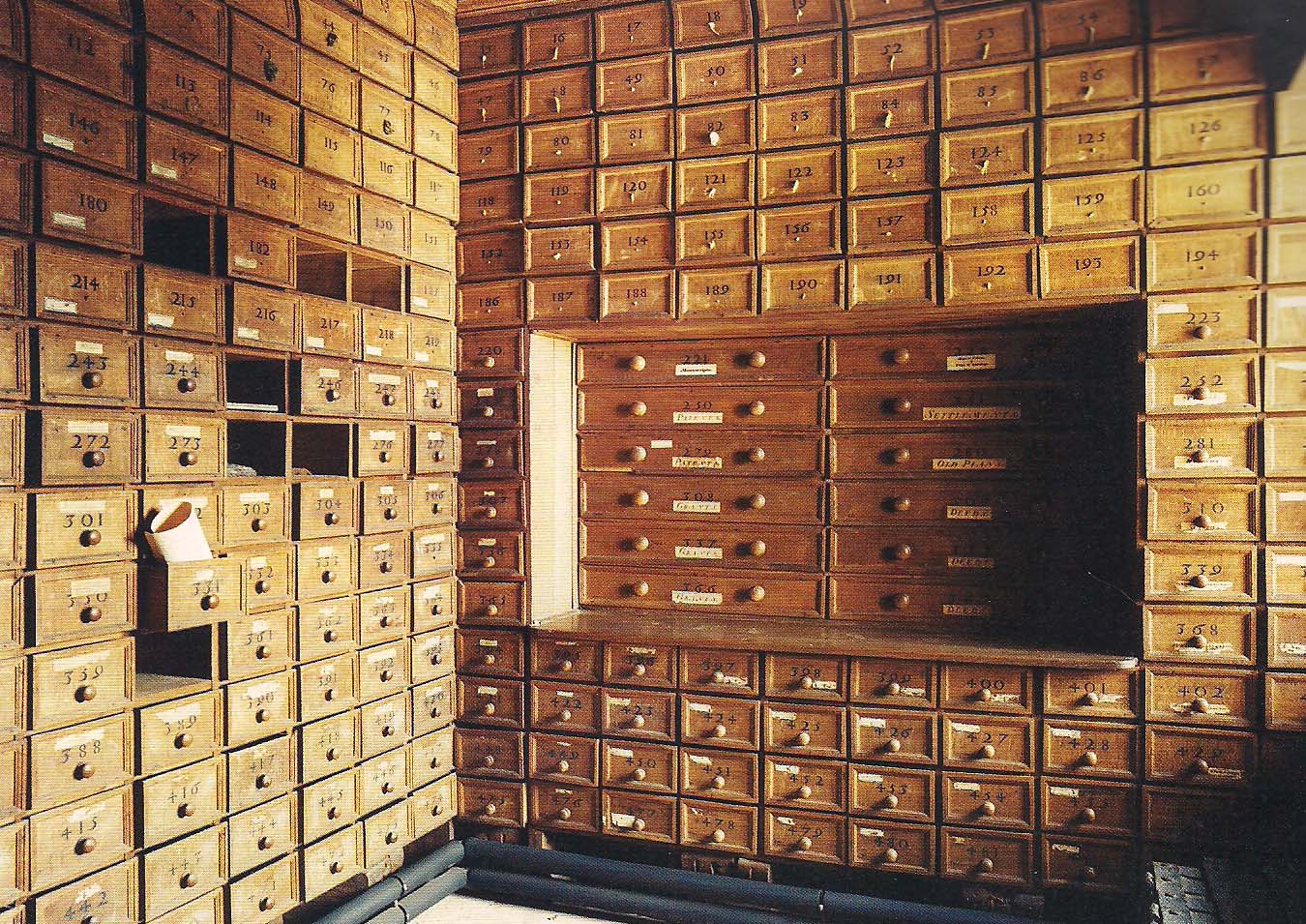
The muniment (ownership document) room on the ground floor of Hardwick Hall is lined with drawers labeled with the names of the Cavendish properties.  In 1956, Hardwick Hall was presented to HM Treasury in lieu of Estate Duty.  In 1959, the property was transfered to the National Trust which now maintains the house and grounds;  it is open year around except for the end of December and the month of January.  All these photos were taken by Anthony Crolla and appeared in the November, 2008, issue of "The World of Interiors" magazine;  favored rate subscriptions are available here.

"Custodians, Collectors, and Taste-makers:  The Cavendish Women at Chatsworth" is a lecture that looks at the five centuries of influences by Cavendish women on English history and style.  It will be presented by Simon Seligman who worked at Chatsworth for 19 years as Education Manager and recently as Head of Communications.  He served the late 11th Duke of Devonshire and his wife, now Dowager Duchess, for 13 years, before becoming part of the team supporting the present 12th Duke and Duchess.  The talk will also detail the remarkable project currently underway to restore and refurbish Chatsworth;  the master plan includes the first ever cleaning of exterior stonework, the creation of new galleries for visitors, a restoration of historic interiors and extensive conservation of the collections.  The lecture at Memphis Brooks Museum of Art at 2:00 pm on Sunday, October 9, 2012, is sponsored as an educational event by Decorative Arts Trust, and admission to the talk is free.