Showing posts with label Jane and Charles Engelhard. Show all posts

Friday, October 19, 2012

The Brilliance of Tiffany

Detail of the Dragonfyl Hanging Lampshade.
Tiffany Studios, New York, 1900 to 1905.
The Neustadt Collection of Tiffany Glass,
Long Island City, New York.
"The Brilliance of Tiffany:  Lamps from the Neustadt Collection" is an illuminating exhibition now on view at Memphis Brooks Museum of Art through January 13, 2013.  Thirty five lamps on loan from the Neustadt Collection, Long Island City, New York, form the core of the exhibit, amply supplemented by Tiffany silver and Favrile glass from both the Brooks permanent collection and items on loan from local private collections.  It is all expertly organized by the Brooks Curator of European and Decorative Art, Stanton Thomas.
Louis Comfort Tiffany.
Image:  Neustadt Collection.
Louis Comfort Tiffany, 1848 to 1933, son of Charles Lewis Tiffany who was the founder of the luxury retailer Tiffany & Company, started as a landscape painter, eventually branching out into interior design and the decorative arts, becoming one of the foremost artists of his time.  In 1869, Tiffany established a studio in the new headquarters of the New York City chapter of the Young Men's Christian Association, the YMCA Building by Renwick and Sands.  But it was Tiffany's design for his own residence at the Bella Apartments that caused a sensation when completed in 1878.  Read about "the fly-eye of New York" as O. Henry called it, in two articles from the early 1880s posted in the Half Pudding Half Sauce blog here.  In 1880, Tiffany established the interior design firm Louis C. Tiffany, Associated Artists with partners Lockwood DeForest (furniture and woodwork specialist), Candace Wheeler (textile and embroidery specialist, often credited as the Mother of American Interior Design) and Samuel Colman (a former Hudson River School artist who became one of the country's first professional interior designers). 

Tiffany Studios, New York City.
Image:  Macklowe Gallery.
In 1883, Tiffany left Louis C. Tiffany, Associated Artists to form his own glassmaking firm, first known as Tiffany Glass and later, Tiffany Studios.  When his father's magnificent Romanesque Revival house commissioned from architects McKim, Mead & White was completed in 1885 on the northeast corner of East 72nd Street and Madison Avenue, New York City, L.C. Tiffany and his family occupied the top two floors.

The Charles Lewis Tiffany residence,
East 72nd Street and Madison Avenue.
Image:  Macklowe Gallery.
Although he continued to collaborate on interior design projects, Tiffany built large workshops and furnaces in Corona, Queens, New York in 1893 and registered "Favrile" as the trademark for his iridescent glass that same year.  Tiffany had become interested in the artistic effects of elecric lights, especially after his collaboration with Thomas Edison for the Lyceum Theater, the first theater to  have electric lights.  The growing availability of electricity provided the impetus for producing commercial lamps in 1895, although the early ones were kerosene and then with the option of either kerosene or electricity.  In 1900, Associated Artists was reorganized as Tiffany Studios.
Laurelton Hall, Laurel Hollow, Long Island.
Image: David Aronow, circa 1924 view, 
Historic American Building Survey.
Louis Comfort Tiffany became the Artistic Director of Tiffany & Company in 1902, following his father's death.  Art jewelry, copper enamels and pottery designed by Tiffany wered added to the retail offerings.  Tiffany's grand estate, Laurelton Hall, was completed in 1905 in Laurel Hollow, Long Island;  it was destroyed by fire in 1957 with its mosaic-decorated loggia installed in the Englehard Court of the Metropolitan Museum of Art in the 1970s.  (Devoted Readers will recall reading about benefactors Jane and Charles Englehard and their estate Cragwood here).  Louis Comfort Tiffany died in 1933 at the age of 85.
Dragonfly Hanging Lamp.
Tiffany Studios, New York.
The Neustadt Collection of Tiffany Glass,
Long Island City, New York.
Despite the many facets of his career, Louis Comfort Tiffany is best remembered for his colored glass lampshades.  These lampshades were influenced by his experience in painting nature, and his exposure to Art Nouveau with his several exhibitions in Paris in the late nineteenth and early twentieth centuries.  The Dragonfly Hanging Lamp, 1900 to 1905, exemplifies these influences.

Pond Lily Library Lamp.
Tiffany Studios, New York.
The Neustadt Collection of Tiffany Glass,
Long Island City, New York.
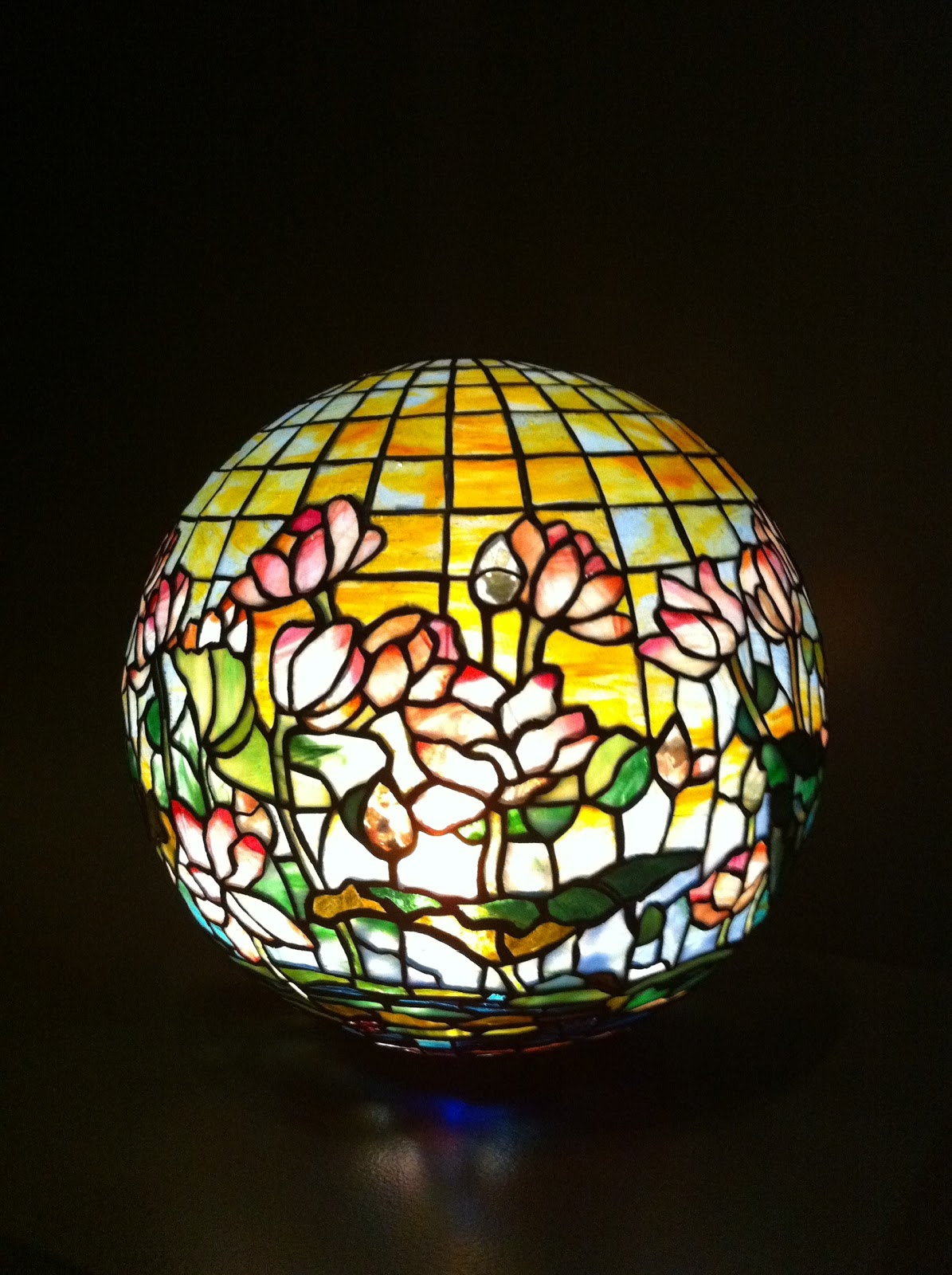
There were several variations on the Pond Lily shade shapes with a library lamp shown here.  The large, hardy, white water lily, Nymphaea odorata, is depicted on the table lamp.  A globe lamp, probably for a newel post lamp, features Nelumbo nucifera, or sacred lotus.

The Pond Lily globe.
Photo by permission of the curator,
Memphis Brooks Museum of Art.
Image:  John J. Tackett for The Devoted Classicist.
The lampshades were assembled on a wooden mold with different molds for the various shades offered.  Brass patterns provided guides for cutting glass, with many colors and effects created in the studio's own furnaces.  Each piece was wrapped in a thin strip of copper foil and placed on the mold, and then the edges were soldered together.

Using the wood mold to fabricate a Tiffany Shade.
Photo with permission of the curator,
Memphis Brooks Museum of Art.
Image:  John J. Tackett for The Devoted Classicist.
Lindsy Parrott, Director & Curator of the Neustadt Collection, will give two talks in Memphis in conjunction with the exhibit.  On Saturday, November 17, 2012, Ms Parrott will talk at 3:00 pm about the seven Tiffany windows at Grace-St. Luke's Episcopal Church in a Decorative Arts Trust event open free to the public;  this lecture will be given at the church located on Peabody Avenue at Belvedere Boulevard.  On Sunday, November 18, 2012, Ms Parrott will talk at 2:00 pm at Memphis Brooks Museum about the artistry and historical context of the lamps in the exhibit;  this second event is free with museum admission. 

Sunday, August 7, 2011

Aaron Shikler Portraits


The portrait of the Engelhard parrot Jacob by Aaron Shikler.
 Noted portrait artist Aaron Shikler, born 1922, was a personal friend of Charles and Jane Englehard who were profiled in my June 6, 2011, post here with some of the contents from their house Cragwood featured in my June 21, 2011, post here.  The portrait of Sister Parish with her dog Yummy in the previous post of The Devoted Classicist reminded me of the portrait I admired so much of the Engelhard's parrot, Jacob.  While Jacob's portrait was included in the sale of the contents of Cragwood, the Shikler portrait of Mrs. Engelhard was not.  Beginning with a 1959 breakthrough commission, Jane Engelhard became a major patron of Shikler, eventually commissioning the Lady Bird portrait, one of Mike Mansfield for the U.S. Senate, and another of the Duchess of Windsor, among others.

Portrait of Mrs. Charles W. Engelhard, Jr. by Aaron Shikler.
 Aaron Shikler studied at The Barnes Foundation in Marion, Pennsylvania and at the Tyler School of Art, Temple University in Philadelphia with a stint in Europe between serving as a map-maker during WWII.  Returning to New York in 1949, he worked in the studio of Hans Hoffman, the Abstract Expressionist.

Portrait of John Kennedy, Jr., by Aaron Shikler.
Whether the recommendation came through her friend Jane Engelhard is unknown, but Jacqueline Kennedy commissioned the artist to do a portrait of young Caroline and John Kennedy in 1968, followed by others of Mrs. Kennedy alone and the three together.


Portrait of Jacqueline Kennedy by Aaron Shikler.
 Appreciating his artistic style and ability to please the client, Mrs. Kennedy asked Shikler to paint her official White House portrait, perhaps the most memorable of all the First Lady portraits.

Preliminary study for official White House portrait of First Lady Jacqueline Kennedy by Aaron Shikler.

A view of the White House Vermeil Room during the Reagan Administration showing the Aaron Shikler portrait of First Lady Jacqueline Kennedy above the settee to the left.
Photo from DREAM HOUSE, THE WHITE HOUSE AS AN AMERICAN HOME by Ulysses Grant Dietz and Sam Waters, Acanthus Press, 2009.
Shikler also painted the White House portrait of President John F. Kennedy, with Mrs. Kennedy's guidance.  She stipulated that there were to be no bags under his eyes and no penetrating gaze.

A 1962 sketch of President John F. Kennedy by Aaron Shikler from the Engelhard collection at Cragwood.
After producing a number of sketches for consideration, Mrs. Kennedy chose the pose with folded arms and lowered head that was adapted from a photo of Ted Kennedy in a similar stance at JFK's grave.  While it was controversial as some said the unconventional pose was not appropriate for the White House setting, many have found the portrait moving.

The official White House portrait of President John F. Kennedy by Aaron Shikler.
 Other White House portraits for President Lyndon B. Johnson, President Ronald Reagan, and First Lady Nancy Reagan followed.  A 1981 article in People magazine stated his then-current fee started at $25,000 for a head and shoulder portrait and $35,000 for for a full figure portrait.  A portrait of Jordan's Queen Noor was $140,000, however.   He no longer allowed input from the sitter, the story said, after an experience with the subject feeling the image was not flattering enough.

Thanks go to P. Gaye Tapp at the wonderful blog Little Augury for directing me to the blog Privilege.  Shikler also painted a portrait of the blog author Lisa, her brother, and her sister which can be seen here.

The display of portraits seems to have fallen out of favor these days in residential decoration, but do you not think there is a place for good portraits in stylish interior design?


The 2009 book Dream House, The White House as an American Home is available for purchase at a discount from the published price and the option of free shipping through The Devoted Classicist Library by clicking here.

Tuesday, June 21, 2011

Cragwood Furnishings

As promised in the previous post of The Devoted Classicist, this will show some of the furnishings from the notable house, Cragwood, as it appeared when it was the residence of Mrs. Charles (Jane) Engelhard, Jr.,  The interiors were decorated by Parish-Hadley, my former employer, and only a few limited photos were ever published, to my knowledge. 
Many wonderful projects from Parish-Hadley will, unfortunately, never be seen by the general public because of privacy issues.  (This is also an issue with my own John Tackett Design projects).  The source of all these images and their descriptions are from the auction catalogue, code CRAGWOOD-1596, that took place a year after Jane Engelhard's death, but 15 years after she had sold the house.  Although the views of the interior are not of great quality, they do show an accurate record of how the house actually looked, and not propped or rearranged just for a photo shoot.  Dollar amounts are not usually a feature of this blog, but since these are in the public domain, the realized auction prices, including the buyer's premium, are included for educational purposes.  Many standard, traditional decorative arts terms are illustrated, so it is hoped this will be a useful reference as well.
Sister Parish contended that a proper Living Room had at least three seating groups, and the Big Room, as it was called at Cragwood, illustrates that point.  Decorating styles can sometime be hard to catagorize;  while this room's contents were all carefully considered, I hestitate but call it an Undecorated Style.  More edited and curated than the Eclectic Style popular today, there is no mistaking that the resulting intent was to show a home whose owners were secure in a position of wealth and good taste.

One end of the room is anchored by a very rare Kesi trompe l'oeil twelve-panel screen from the Qianlong period (1736-1795).  $408,000.
An Austro-Hungarian stool,, with white painted and parcel gilt decoration was almost certainly part of a salon suite made for the Erdody Palace, Budapest, and may have originally had a fan-shaped padded back.  Circa 1800.  $21,600.
A pair of French ormolu-mounted Chinese powder-blue porcelain baluster vases were installed as overdoor decoration.  The Kangxi (1662-1722) porcelain was cut down to accommodate the mounts, probably 19th century. $12,000.
An Italian Empire giltwood center table with porphyry top, circa 1803-06, was almost certainly ordered by Cardinal Joseph Fesch, uncle of Napoleon I, for his residence in Rome, Palais del Buffalo-Ferraioli.  The 45 inch diameter top is particularly impressive.  $168,000.
A pair of Buddhistic lions, a male and a female, glazed in green, amber, and cream are from the Qing Dynasty (1644-1911).  $2,280.
A Louis XVI ormolu-mounted tulipwood, amaranth and mahogany tric-trac table is stamped "J. POTARANGE JME", late 18th century.  Tric-trac is a game that uses the same equipment as backgammon; the top lifts off to reveal the playing surface.  $14,400.
A pair of Louis XVI voyeuses, from the late 18th century, were originally intended to be sat on backwards.  (This form should not be confused with a prie dieu).  $18,000.
The Venetian etched glass mirror, 20th century, hung over the fireplace.  $46,000.
A Louis XVI ormolu and white marble lyre mantel clock has the signature "Bourdier a Paris" on the dial.  Circa 1790.  $31,200.
A pair of porcelain Hochst models of parrots, circa 1752, on later German ormolu bases in the Louis XV style were thought to be from a Sotheby's London auction in 1965.  $156,000.
A pair of Anglo-Irish cut-glass two-light candelabra, late 19th century, were placed on the mantel with black candles, another Sister Parish trademark.  $1,200.
A pair of late Louis XV ormolu chenets are stamped "FF" and "FEUCHETE".  Circa 1765-1770.  $33,600.
A Chinese style gilt and black lacquer low table, 20th century.  $4,200.
A Bristol tankard, circa 1770, is 5 5/8" high.  $2,280.


A wonderful lacquer cabinet visually balances the Kesi screen at the other end of the room.

A Regence bois satine and Chinese and European lacquer armoire, signed and dated Louis Guidnard, 1723.  The Chinese lacquer panels are 18th century, probably cut from a screen.  $180,000.

A pair of English giltwood and faux marble brackets are from Stair & Company, New York, probably 20th century.  $3,340.

A pair of Meissen models of Jays (Eichelhaher), circa 1740, were modelled by J.J. Kandler.  $22,800.

A pair of George III white-painted and parcel-gilt armchairs, circa 1780, bear a Norman Adams, London, label.  $45,600.

A near set of six Louis XVI giltwood  fauteuils from the late 18th century had been regilded.

The giltwood and gilt composition lectern from Central Europe is 49 inches tall and dates from the first half of the 19th century with the rockwork platform later. 

I could be mistaken, but I am thinking that this is a slightly earlier view of the Big Room.  There are only a few adjustments and relocations.

A Chinese export porcelain "Canton Famille Rose" part dinner service, 19th century, is decorated in the "Thousand Butterfly" pattern.  $22,800.
A pair of ormolu-mounted Meissen porcelain potpourri pierced baluster-form vases, circa 1750, have German and French flower decorations, 18th/19th century.  The associated tole inserts and the mounts are probably 18th century.  $36,000.
A pair of part-silvered brackets are in the form of a scroll issuing acanthus.  $2,400.
A set of four George III giltwood armchairsare in the manner of Gillow, circa 1775.  $20,400.
A Regency giltwood center table, second quarter of the 19th century, has an associated French top.  $25,250.
A Louis XV ormolu cartel clock, mid-18th century, has the movement and dial signed Olin a Paris.  $19,200.
A pair of Louis XVI ormolu and porphyry busts of Marie Antoinette and Louis XVI date from the late 18th century.  $14,400.
This sale on Friday, March 18, 2005, totalled $4,409,160 including the buyer's premiums.  As mentioned in the previous post, items from Mrs. Engelhard's estate was also included in the April 12, 2005, auction "Magnificent Jewels", the March 17, 2005, auction "Old Master Drawings", the March 30, 2005, auction of "Important Chinese Ceramics and Works of Art", and the June 14, 2005, auction of "Fine Printed Books and Manuscripts", all Christie's New York.

The ring with a 34.15 carat rectangular-cut diamond, flanked by marquise-cut and circular cut diamonds in a platinum setting was designed by Van Cleef and Arpels.  $1,080,000.