Showing posts with label Treillage. Show all posts

Monday, April 14, 2014

Pavillon Frais Restoration

The garden of Le Pavillon Frais
near the Petit Trianon.
Photo: Versailles.
J'adore le treillage!  Yes, Bunny Williams' and John Rosselli's shop of course, but I am referring to the French term for architectural trellis-work, treillage.
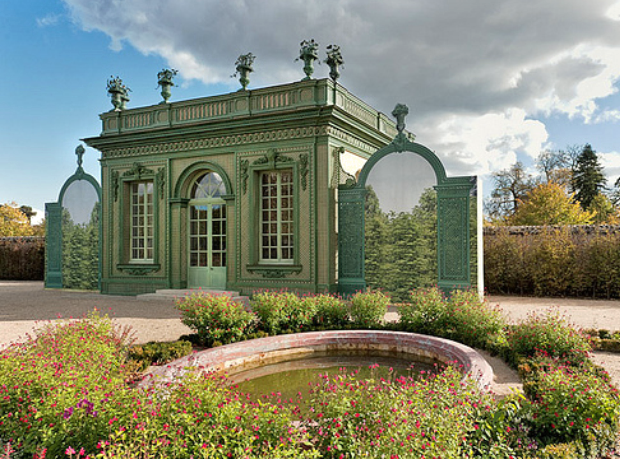
Pavillon Frais with partial mock-ups
of the flanking arcades.
Photo: Versailles.
There is a small garden structure near the Petit Trianon at Versailles that is sometimes referred to as the Pavillon du Treillage because it was covered with trellis-work.  But the official website of the chateau refers to it as Pavillon Frais, so that name will be used here.  Both the building and the surrounding garden have recently undergone a very interesting restoration.

Drawing of Pavillon Frais dated December, 1751.
Image: Archives Nationales.
At the encouragement of Madame de Pompadour, King Louis XV settled at the Grand Trianon in 1749, away from the rigid court formality of the palace, and away from the courtiers who disapproved of her being the favorite of the king.  (Previously, the mistress of the king was of high noble birth, but Jeanne Antoinette Poisson who was given the title of Marquise by the king came from a non-aristocratic background, though she was particularly well-educated).  The royal architect Angel-Jacques Gabriel designed additional Trianon gardens and, in 1750, was asked to design a pavilion in the middle of a garden laid out in geometric beds, contrasting with the trend in English gardens for a more natural landscape.  Both the pavilion and the garden began to be known as "French" because of this new style.  A menagerie was added nearby, not for exotic animals, but for cows, chickens, and similar animals.  In 1751, another small pavilion designed by Gabriel was added consisting of a small dining room where the fresh products of the diary and vegetable gardens could be served;  this was known as the Pavillon Frais.


In this site plan, the Pavillon Frais is in the lower left corner
above the wording "Avenue".
The French pavilion is the shaped building above it.
Image: American Friends of Versailles.
The garden in front of the pavilion was surrounded by trellis-work creating a courtyard.  An arcade of trellis covered iron supports against a dense hedge flanked the pavilion, installed in July, 1752, at the same time as the trellis design covering the pavilion.

In this site plan detail, the Pavillon Frais
can be made out, backing up to the tree-lined avenue,
with the courtyard garden in front, above.
Image: Versailles.
The entrance to the garden consisted of lattice piers built around the trunks of lime trees pruned into the shape of spheres.  The main piers were like the pilasters of the pavilion and mounted with large wooden trellis urns.  Fifty-four smaller urns adorned the keystones of the archways of the arcades, each with an orange tree.  In 1756, statues of "Illness" and "Health" from the Antiques Room of the Louvre were placed on marble plinths at each end of the arcades.

This 1751 plan of Pavillon Frais by Gabriel has a reversed orientation
from the two previous garden plans,
with the northern direction towards the bottom.
Image:  Wikimedia.
The one room interior was primarily used for dining on pleasant spring and summer days, although there was a fireplace with a Languedoc marble chimneypiece.  The walls were painted boiserie decorated with carved floral garlands and inset sheets of mirrored glass.  The floor was a black & while marble checkerboard covered with a large Savonnerie carpet, commissioned in 1754 but not completed until 1760.  The furniture included two canapés and two fauteuils upholstered in green & white toile de perse, a chic but casual cotton fabric with a printed Persian floral design.  A later inventory also included sixteen assorted side chairs.

The interior of Pavillon Frais
as it appeared in 2013,
with representations of the boiserie.
Image: Wikimedia.
The pavilion was essentially destroyed in 1810, with only the foundation remaining, and the lattice courtyard enclosure was pulled down the next year.  Some restoration was begun in 1980, enabling the stone structure to be reconstructed, but more progress was realized when a support group, The American Friends of Versailles, took the project on.

The restored garden elevation of Pavillon Frais
by the office of the Chief Architect of Historic Monuments,
Pierre-Andre Lablaude.
Image:  the Facebook page of
The American Friends of Versailles.
Test pits and archaeological excavations found the original locations of the basins as well as fragments of their remains.

'Before' and 'After' views of Pavillon Frais
showing the restoration efforts of
The American Friends of Versailles.
Images: Facebook.
The fragments of the bottom of the basins revealed a mosaic design in marble that were reproduced in the restoration.

One of the pair of restored basins
in the garden of Pavillon Frais.
Image: Facebook.
The flanking arcades and courtyard enclosure have not been recreated, but a representation of how that would look is given with two flat theatrical mock-ups flanking the pavilion.

The back of the arcade mock-up
at the Pavillon Frais.
Image: Facebook.
The treillage on the building has been wonderfully restored, however, by the French company which specializes in such work, Tricotel.

The restored entrance doors of
Le Pavillon Frais.
Photo: Tricotel.


The original layout of treillage
was created for Pavillon Frais.
Photo: Tricotel.
With the success of the work so far, perhaps the recreation of the interior and the arcades will follow.  The American Friends of Versailles has also sponsored the restoration of the Trois Fontaines Bosquet and is dedicated to preserving interest in Versailles through seminars and educational exchanges as well as specific restoration projects at the palace and its gardens.

Le Pavillon Frais.
Photo: Tricotel.
Those more interested in plant material than garden structures will enjoy Elisabeth de Feudeau's book published in September, 2013, FROM MARIE ANTOINETTE'S GARDEN: AN EIGHTEENTH-CENTURY HORTICULTURAL ALBUM.  Based on archival documents, the book uses eighteenth-century illustrations to present the plants, flowers and trees loved for their beauty, scent, and herbal qualities.

Monday, January 23, 2012

Decorative Painting, Part 3

An interior design project by Bunny Williams in Richmond, Virginia, features decorative painting by Bob Christian.
Photo from Architectural Digest, January, 2012.

One of The Devoted Classicist's favorite motifs in decorative painting on walls is draped fabric.  A very effective but relatively subtle example of this is seen in a Richmond, Virginia, house decorated by Bunny Williams and featured in the January issue of Architectural Digest magazine.  The painting was executed by Bob Christian Decorative Art.  After studying painting in art school and training under John Rosselli, Bunny's husband and owner of several To-The-Trade businesses in addition to the retail shops Treillage, Ltd. they founded together before their marriage, Mr. Christian relocated to Savannah, Georgia, where his wife owns Julia Christian Gallery, a retail outlet for paintings by both of them.
Homeowners Helga and Floyd Gottwald, Jr., pose in the entrance hall of their Richmond home decorated by Bunny Williams.
Photo from Architectural Digest, January, 2012.

Although the scheme does not completely cover the walls, or even the whole room, the photo with the homeowners gives a good representation of how the decorative painting helps tie together the large-scaled architectural detailing by Jay Hugo of 3north. 
The wife's sitting room in a North California project by Suzanne Rheinstein with decorative painting by Bob Christian.
Photo from Architectural Digest, December, 2011.

Another of my other favorite motifs for decorative painting on walls is trellis work.  Coincidently, here is another example of painting by Bob Christian, this time in a house in Northern California decorated by Suzanne Rheinstein with architecture by Ken Linsteadt in the December issue of Architectural Digest.  The decorative painting helps lift the low large-scaled cove with a representation of bamboo used to give the treillage a lighter appearance.  The potted flowers are a reference to her home furnishings shop Hollyhock.

Decorative Painting, Part One can be viewed here and Decorative Painting, Part Two can be viewed here.  More of the work of interior designer Bunny Williams can be seen in her book BUNNY WILLIAMS' POINT OF VIEW:  THREE DECADES OF DECORATING ELEGANT AND COMFORTABLE HOUSES, available at a discount here.  Suzanne Rheinstein's own homes and some projects are shown in her book AT HOME:  A STYLE FOR TODAY WITH THINGS FROM THE PAST, available at a discount here.  A favored rate subscription to Architectural Digest magazine is offered here.

Friday, July 8, 2011

Garden Room Revealed

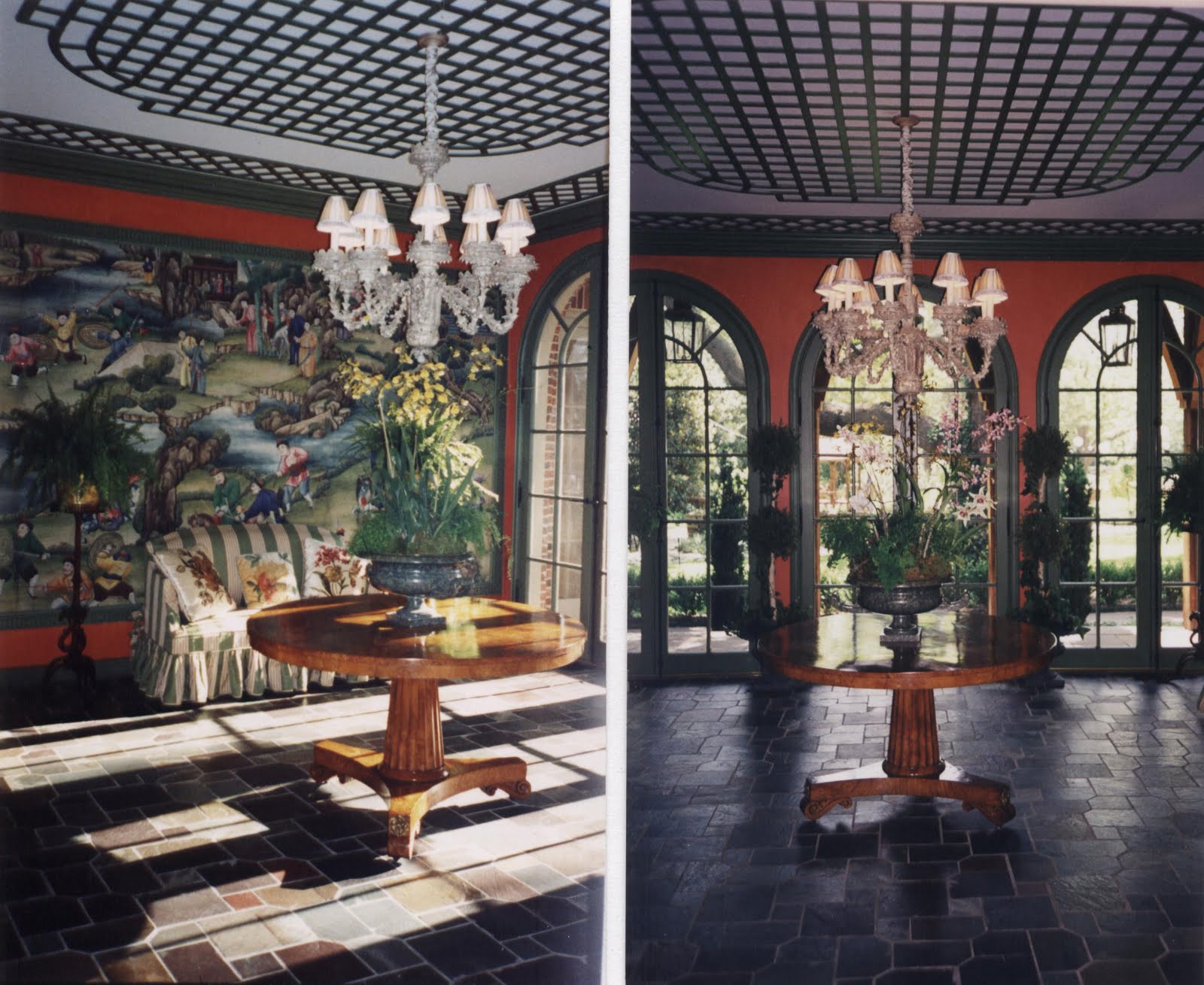
The Garden Room of a house in the Volk Estates section of University Park, Dallas, Texas, renovated by John Tackett Design.
Photo by Pieter Estersohn.
A number of blogs, including two of my favorites, The Peak of Chic and Me & Mrs. Jones, have featured the latest book by Florence de Dampierre, Walls:  The Best of Decorative Treatments which was published by Rizzoli this past March.
 
I was delighted to learn that a room from one of my projects, an extensive renovation of a 1920s house in the Volk Estates area of University Park, Dallas, Texas was featured.  The book is a little "lite" in text, however, and no identification is given for the room, a peeve that has now moved to the top of my list of Issues With Authors of Design Books.  But The Devoted Classicist is happy to be able to provide more information on the room.

The wallpaper panels as installed in the Dining Room of the owners' previous home, with interior design by Josie McCarthy.
Photo by Peter Woloszynski.
The eighteenth century handpainted wallpaper panels were bought by my clients some years before, and installed in the previous home's Dining Room which was arranged with mouldings in a boiserie effect of black lacquer walls.  But the owners wanted to use them differently in their new residence.

The trio of custom made stools resulted from a 1996 series of velvet covered furniture developed by John Tackett Design.
Photo by Pieter Estersohn.
The space was previously a Florida Room with jalousie windows of glass louvers and a shag carpet over the concrete floor.  With the addition of a new panelled Library on the ground floor, this room became a passage from the adjacent Living Room on one side and a cozy Sitting Room on another, making it essential to create a distinctive space as well as a link to the remarkable garden beyond.

Drawing by John J. Tackett  from construction documents by John Tackett Design.
The six panels were the same length, but of different widths.  The layout of both the room and the panels allowed them to be joined as a large panel on the north and south walls but kept separate to flank a doorway on the east wall.  A design module was devised to allow a fretwork frame that would fit the four resulting widths yet still allow for corners to be resolved.
Views of the Garden Room showing the south and west elevations showing the treillage added to the ceiling and the antique tole chandelier from Marvin Alexander, Inc.  The slipcovered loveseat was relocated for the previous images.
Photos by John J. Tackett, John Tackett Design.
To reinforce the garden theme, a traditional lattice motif was introduced but restricted to the ceiling.  Roofing slates were used for the new flooring and custom French doors open to a new porch.
A scap of the wallpaper from the previous installation was used to develop the paint scheme for the Garden Room.
Photo by John J. Tackett.
The paint scheme for the room was developed on site with the owner and the painter, Barry Martin, who used pigments to mix the colors for review and approval.  The furnishings were a collaboration with Josie McCarthy, who had designed the interiors of the clients' former home.  An admirable job was done by the building contractor Kevin Smith, and Wilson Fuqua provided the documentation for Code Compliance.  The 1999 Pieter Estersohn photos originally appeared in a fourteen page article in "Southern Accents" magazine in 2001.  Some photos of the house also appeared in the 2003 book Southern Accents on Color edited by Frances McDougall.  My clients have since sold the house, now spending more time at another project I designed for them in Pebble Beach, California.  But additional aspects of this Vassar Avenue house will be featured in future posts of The Devoted Classicist.

The 2011 book WALLS: THE BEST OF DECORATIVE TREATMENTS can be ordered at a discount of 30% off the published price with the option of free shipping by clicking here to visit The Devoted Classicist Library.